(Clearwisdom.net) This March, NASA released an image of a galaxy, NGC 7673, photographed by Hubble Space Telescope. The bright blue light in the image showed that the galaxy is ablaze with light from millions of immense new stars. Each of its infant giant star clusters shines 100 times brighter in the ultraviolet spectrum as similar immense star clusters in our own Milky Way galaxy.
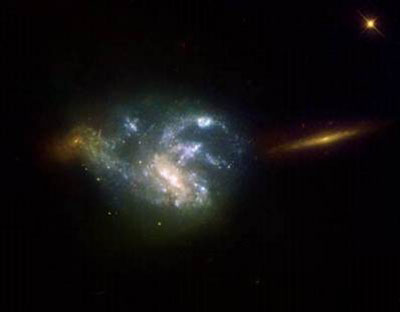
NGC 7673 is located in the constellation of Pegasus. Scientists are amazed at the vigorous star formation in this galaxy. According to Nicole Homeier from the European Southern Observatory, "NGC 7673 is a nearby example of the type of vigorous star formation that we think may have taken place in the early universe. Our most pressing questions are: What has triggered this enormous burst of star formation and how will the galaxy evolve in the future?"
Recently, astronomers discovered in a broad scope of the universe many astonishing astronomic phenomena, such as massive star formations caused by galaxies colliding; the mysterious formation of immense new stars in ancient galaxies; formation of new galaxies and quasi-solar systems; frequent bursts of supernovas and Gamma ray eruption and so on. These discoveries reveal the mystery of the universe and its vigorous changes, and also pose a tremendous challenge for the current cosmology.
In ancient China, people believed that by observing the heavens, they could foretell important events. Moreover, they could usually predict accurately the occurrence of various significant social changes. Therefore, it is very important and significant to explore the reasons behind the above-mentioned amazing astronomic phenomena.