(Clearwisdom.net)
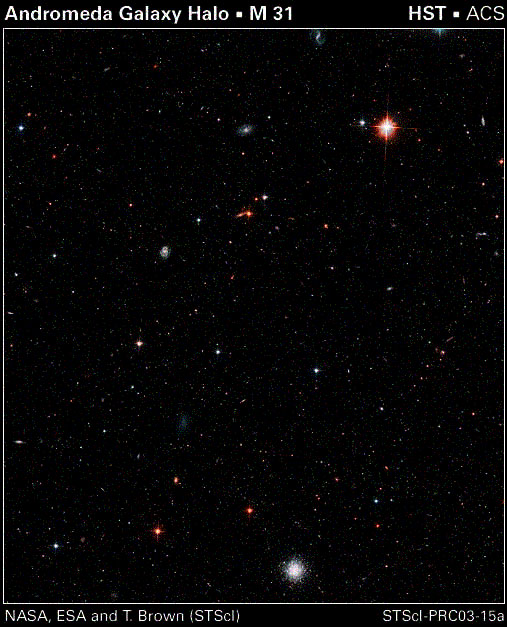
Relying on the deepest visible-light images ever taken in space, astronomers using NASA's Hubble Space Telescope (HST) have reliably measured the age of the spherical halo of stars surrounding the neighboring Andromeda galaxy (M31).
To their surprise, they have discovered that approximately one-third of the stars in Andromeda's halo formed only 6 to 8 billion years ago. That's a far cry from the 11-to-13 billion-year age of the stars in the Milky Way's halo.
Why the difference in halo ages? You might call it a tale of rich galaxy/poor galaxy. Apparently, M31 must have gone through a major "corporate merger" with another large galaxy, or a series of mergers with smaller galaxies, billions of years ago. Astronomers cannot yet tell whether this was one tumultuous event or a more continual acquisition of smaller galaxies. The newly discovered younger stars in Andromeda's halo are richer in heavier elements than the stars in our Milky Way's halo, or in most of the small dwarf galaxies that surround the Milky Way. Indeed the level of chemical enrichment seen in these younger stars is characteristic of relatively massive galaxies, containing at least a billion stars.
This suggests three possibilities: (1) Collisions destroyed the young disk of M31 and dispersed many of its stars into the halo; (2) a single collision destroyed a relatively massive invading galaxy and dispersed its stars and some of Andromeda's disk stars into the halo; and/or (3) many stars formed during the collision itself.
Astronomers say it will take more detailed observations to unravel the acquisition history of these early cataclysmic events. Located only 2.5 million light-years away, the magnificent Andromeda galaxy, visible as a naked-eye spindle of light in the autumn sky has long been considered a near twin to our Milky Way in terms of size, shape, and age. [...]
Previously, telescopes could only see the bright giant stars in the halo population, but the population of "normal" stars like our own Sun was beyond our grasp, because such stars in M31 are so faint. The ACS is the first astronomical camera to combine ultra-sharp vision and sensitivity to ferret out M31's faint halo population.
An estimated 300,000 of these never-before-seen halo stars can be resolved, peppering Hubble's narrow sample of the halo population. Looking far beyond the halo stars, Hubble reveals thousands of background galaxies (down to 31st magnitude) billions of light-years away.
A large fraction of the background galaxies in the image also have peculiar shapes due to collisions. This reinforces the fact: we live in a vibrant and dynamic universe undergoing constant change.
Release Date: 9:45AM (EDT) May 7, 2003
Release Number: STScI-2003-15