World Attention Focused on Psychiatric Abuse of Falun Gong Practitioners in China, Part 1 (Photos)
(Clearwisdom.net) The plan for the World Psychiatry Association (WPA) to visit Beijing and conduct an independent inspection of Falun Gong practitioners being held in mental hospitals was suddenly suspended due to a letter from Chairman of the CSP (Chinese Society of Psychiatry) on March 26, 2004. The letter stated that China would not be following the agreement it had reached with the WPA earlier. Some observers doubted this "explanation," and pointed out how China was trying to avoid the inspection for fear of the truth being revealed.
Shortly after the government ban of Falun Gong in July of 1999, cases of psychiatric abuse of mentally-healthy Falun Gong practitioners have been reported from China through human rights groups and the international media. The large number of cases, which reflect the extent and severity of the persecution in China, was thereby brought to the attention of the international community.
In 2000, The First Death Case from Psychiatric Abuse Was Revealed
On June 18, 2000, Reuters reported the case of Su Gang, a young computer engineer and Falun Gong practitioner in Zibo, Shandong Province, who died of repeated injections of drugs in a mental hospital. Since then, cases of Falun Gong practitioners being detained in mental hospitals and rehabilitation centers have been constantly reported by RFA, Reuters, AP, and other overseas media.
Before and after the case was disclosed by international media, the major website of Falun Gong, Clearwisdom Net, reported many similar cases. Their information was sent out of China despite the strict information blockade. Many mentally healthy practitioners were tortured to death by the psychiatric abuse. Bringing these cases to light would shock the world.
The Report of Dr. Munro
Robin Munro, a Senior Research Fellow at the London School of Oriental and African Studies, said in a 130 page report entitled, China's Psychiatric Treatment in Legal Systems and Its Abuse for Political Reasons, that the Chinese government is detaining Falun Gong practitioners in mental hospitals, and running a smear campaign to eliminate the Falun Gong movement.
Until 1999, British citizen Robin Munro was director of the Hong Kong bureau of the human rights organization, Human Rights Watch (HRW). He wrote his study about psychiatry in China as a Senior Research Fellow at the London School of Oriental and African Studies (SOAS), where he had been a researcher since 1999.
In his report, published in the Columbia Asian Law Journal, Munro said that before July 1999 when China banned Falun Gong, there was an evident decrease of mental-hospitalization of people for political reasons.
According to Munro, the Department of Public Security in China has administration of some special hospitals to detain criminals with mental problems. Yet political dissidents are also detained there. Right now, Falun Gong practitioners are treated the same. Munro also said that it was a system learned from the former Soviet Union.
On Feb.24, 2001, Saarbrueker Zeitung (an internationally recognized newspaper in Germany) carried an interview with Dr. Munro by Kai Strittmatter. In answering the question, "What caused the increase in admissions to psychiatric institutions?" Munro pointed out that it has to do with the measures the Chinese government was taking against Falun Gong. He said, "The followers of this movement present a special case." He went on to say that it has to do with their worldview and their open and fearless protest. "In China, for a long time there has existed an official, recognized diagnosis of mental derangement, which goes back to the practice of qigong (a traditional method of healing). If the government is criticizing a movement such as Falun Gong, it will make use of the phenomenon of "over-diagnoses," (i.e. designating as "sick" those who are actually healthy), to great advantage.
When emphasizing the origin of the cases in his report, Munro said, "My evidence comes from official public sources."
The 100-page Report Released by Falun Gong Practitioners in 2001
The Falun Information Center in New York released a 100-page report in March 2001 on China's psychiatric abuse. According to its incomplete statistics, there had been 123 practitioners sent to mental hospitals by January 8, 2001.
The report is based on the description of the victims. It provides first-hand materials for the world psychiatric community and the human rights organizations.
American and British Psychiatric Association Urge Independent Inspections of the WPA
On April 7, 2001, the British Medical Journal said in its comprehensive news report that the American Psychiatric Association had urged the WPA to protest against China for its detention of dissidents and Falun Gong practitioners in mental hospitals.
In May and July of 2001, the American Psychiatric Association and British Psychiatric Association passed resolutions, separately, urging the WPA to conduct an independent inspection on this issue.
WPA and Human Rights Watch Release Detailed Reports
According to Canadian National Radio on August 27, 2002, the WPA released a 300-page report in July 2002, listing specific examples to illustrate psychiatric abuse in China. It said that included among those who were detained in mental hospitals were not only political dissidents, but also Falun Gong practitioners.
In August of 2002, Human Rights Watch and Geneva Psychiatric Treatment Committee jointly released a detailed report of the psychiatric abuse in China. They indicate in the report that China's diagnosis of Falun Gong practitioners who are firm in their beliefs as "mentally ill" violates international standards of psychiatric analysis.
The Annual Conference of WPA in Yokohama Passed a Resolution to Visit Beijing for a Joint Inspection
At the annual conference held in August 2002 in Yokohama, in which 6000 experts composed of psychology and psychiatric doctors from 120 countries attended, a resolution was passed which sought for the WPA (World Psychiatry Association) and CSP (Chinese Society of Psychiatry) to visit Beijing in a joint inspection. It was hoped that the inspection could be finished by 2003.
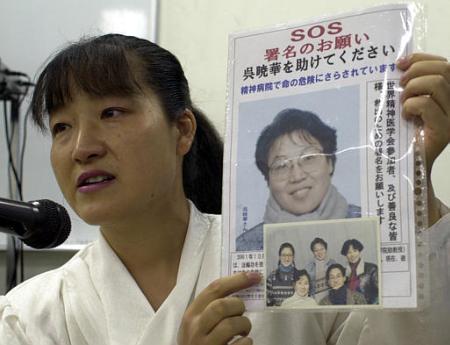
Wu Lili, a younger sister of a practitioner detained in a mental hospital in China, requested help for her sister's release at the press conference on August 27, 2002 in Yokohama (Photos by AP)
WPA Releases Strong Statement in 2003
In May 2003, the WPA decided to release a statement demanding the Chinese government to unconditionally accept WPA's independent inspections.
A former president of the American Academy of Psychiatry and Law Professor Emeritus at New York Medical College, Dr. Abraham Halpern, said, "The statement has finally declared unambiguously and clearly a call for the admission to the PRC of an investigative mission to look into the serious allegations of abuse and misuse of psychiatry in connection with the hospitalization and other kinds of involuntarily psychiatric treatment of non-mentally ill Falun Gong practitioners and political dissidents as well. This statement is much stronger than anybody could have expected, demanding the unrestricted opportunity to visit any hospital that the investigative mission would want to go to; to have their own translators without relying on translators within China itself...I don't think that the Chinese government will ignore it."
 |
|
Dr. Abraham Halpern |
From the time when the WPA conference in Yokohama made the statement that it would be following the psychiatric abuse in China until May 2003, there were 32 new cases made known of Falun Gong practitioners being subjected to psychiatric abuse, including 3 deaths.
One and a half years after the resolution for WPA and SP to hold a joint inspection in Beijing was passed, Beijing is still not cooperating. It was not until January 10 and 11, 2004, when Dr. Okasha, Chairman of WPA, met with Chairman of China's Psychiatric Association and Minister of Public Health that China agreed to the plan for WPA and SP to hold the joint inspection on April 4, 2004. At that time, the U.S. was considering proposing a resolution to the UN Human Rights Committee condemning the deterioration of human rights situations in China. Now things have changed.
"China Mental Health Watch" Writes Letters to WHO
"China Mental Health Watch," an NGO established on November 21, 2003 in New York, is composed of Chinese and western psychiatrists, psychologists, social workers, lawyers, and other volunteers. They wrote a letter to WHO on January 8, 2004, reporting on the psychiatric abuse of Falun Gong practitioners, and called for international support to stop the persecution of practitioners who were also doctors and medical workers. In their letter, they expect WHO, in order to maintain the international standards of medical ethics and human rights, to play its role in preventing the inhumane persecution in China.
Several Thousand People Subjected to Psychiatric Abuse, Dozens Have Died, and Nearly a Hundred Mental Hospitals Are Involved
According to incomplete statistics by 2003, during the almost five years' persecution of Falun Gong, cases of psychiatric abuse are everywhere in the country. Several thousand non-mentally-ill practitioners were detained in mental hospitals and rehabilitation centers. Many received forced injections or feeding of several kinds of nerve-damaging drugs. They were tied-up for long periods of time. They also received electric shock and force-feeding. A lot of them were detained for a long time, some even for more than two years. Some people lost their eye-sight, or hearing, some became completely paralyzed or partially paralyzed. Some completely or partially lost their memory. Some do not have a clear consciousness and are missing. Some people's internal organs were severely damaged. At least ten people have died. Around the country, there are nearly a hundred mental hospitals at district, county, city, and province levels involved in the persecution.
(To be continued)
Written on March 31, 2004