On the Fifth Anniversary of the "April 25 Appeal" -- Remembering April 25, 1999 (Part 2)
[Part 1: http://www.clearwisdom.net/emh/articles/2004/4/26/47425.html]
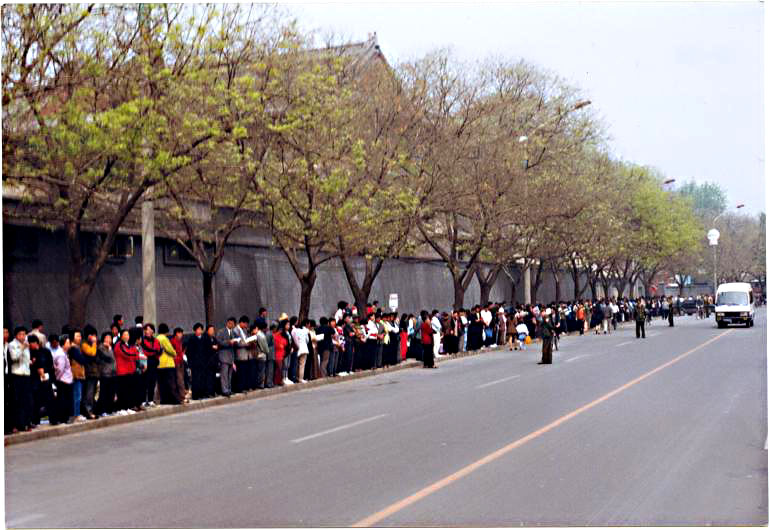
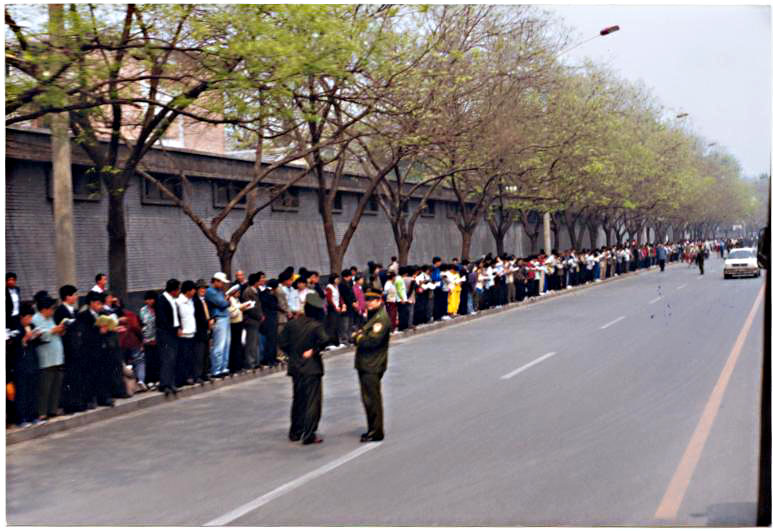
(Clearwisdom.net) Five years ago, on April 25, a momentous event took place in Beijing, China. More than 10,000 Falun Gong practitioners in China went to the Appeals Office of the State Council on Fuyou Street in Beijing to make an appeal in accordance with Chinese law. The peaceful appeal received international attention because of the peacefulness, rationality, good faith, forbearance, self-discipline and high level of social awareness demonstrated by Falun Gong practitioners.
However, on July 20 of the same year, Jiang's regime unexpectedly launched an all-out suppression of Falun Gong, utilizing the entire nation's propaganda tools and every other facet of society under its control. Lies and slander poured out across the country and all over the world. Since then, Falun Gong has been grievously wronged, and many people regard the "April 25th Incident" as "getting involved in politics," or in other words, as a reasonable cause for the suppression.
In this article, I will reflect on the origin and development of the "April 25th Incident," and restore truth to this episode in history. This article's aim is to further describe the facts surrounding the "April 25th Incident," and help people to objectively reflect on the disaster currently unfolding in China.
* * * * *
Part II. Peaceful "April 25 Appeal" Reaches Mutually Satisfactory Outcome
Some people think that the appeal of over 10,000 Falun Gong practitioners on April 25 was the cause of the suppression launched later on. In fact, the peaceful appeal on April 25 was in accordance with the law and done in a reasonable manner. Secondly, due to the concerns of the Chinese premier, Falun Gong practitioners and officials from the Appeals Office of the State Council had come to an agreement through a friendly face-to-face discussion. They reasonably resolved the beating and arrests of Falun Gong practitioners, which had occurred in the city of Tianjin. In the evening, Jiang Zemin, who only "inspected" the scene while sitting in a bulletproof car during the day, wrote a letter to the members of the Standing Committee of the Politburo, imitating Mao Zedong's initiation of the Cultural Revolution. He overrode the decision made by the premier by unilaterally implementing his own plan and by employing methods that were simply underhanded and illegal. Thus, the persecution of Falun Gong was put in motion.
1. Direct Cause: The Tianjin Incident
On April 11, 1999, He Zuoxiu published an article in the Tianjin College of Education's Youth Reader magazine entitled, "I Disagree with Youth Practicing Qigong." In this article, he drew upon the same examples to slander Falun Gong as he had presented on a Beijing TV Station program in 1998. He Zuoxiu's malicious intent in presenting these examples had once led to a protest at Beijing TV Station headquarters. Because these examples had already been fully proven incorrect during the Beijing TV Station incident, this article of his was rejected by Beijing's media and propaganda bureau.
Related article (English):
http://www.clearwisdom.net/emh/articles/2004/3/10/45906.html
The article published by He Zuoxiu in Tianjin City in April 1999 made slanderous remarks and claimed that practicing Falun Gong would cause mental illness, implying that Falun Gong would damage the country and the Party. This article followed the same pattern as many other twisted reports without in-depth analysis that had recently appeared in about a dozen media outlets. Its attack on Falun Gong was in the same vein as the notification entitled, "An Investigation of Falun Gong Has Been Initiated," which was sent out by the First Division of the Public Security Bureau on July 21, 1998. The notification said that Falun Gong was "spreading rumors and dangerous theories" even before it requested that the Political Security Sections of all local Ministry of Public Security offices launch an investigation to find evidence of crime. As a result, the Public Security Offices in Xinjiang and Liaoning Provinces started to consider practitioners' normal group exercise practices as "illegal assemblies" and dispersed Falun Gong practitioners with force, wrongfully confiscated their personal property, and even physically abused, fined, arrested, and detained practitioners.
At the time, Falun Gong practitioners from different areas across the nation were being harassed and put under pressure in many different ways. Furthermore, no media, small or big, across the country would give Falun Gong practitioners a chance to speak for themselves. Under such circumstances, and in accordance with relevant regulations from the Chinese Constitution on the freedom of belief, and based on Item No. 27, Chapter Three of Publishing Administrative Regulations (1), Falun Gong practitioners went to the office of the magazine and other relevant organizations, explaining how they had benefited after practicing Falun Gong, in hopes that the editorial department of the magazine could clarify the truth to the public and lessen the negative impact of the article.
The editors of the magazine first said that they would correct the mistake. However, later on, they suddenly changed their mind and refused to do so. The development of the incident attracted the attention of more and more Falun Gong practitioners, and more and more people went to the office of the magazine to clarify the truth. On April 23 and 24, the Public Security Bureau of Tianjin dispatched riot police to beat up the Falun Gong practitioners who had come to appeal, resulting in physical injuries to the practitioners. The police arrested 45 people.
From incidents in previous years in which defamation was spread through the media, to this incident in which police actually used violence against Falun Gong practitioners in Tianjin, this incident greatly shocked Falun Gong practitioners. Word of the "Tianjin Incident" spread rapidly among local Falun Gong practitioners. When Falun Gong practitioners requested the release of the detained practitioners, they were told at Tianjin City Hall that the Public Security Bureau had become involved in this matter, so the arrested Falun Gong practitioners would not be released without authorization from Beijing. The Tianjin police told Falun Gong practitioners, "Go to Beijing. Only going to Beijing can resolve the problem."
Up to that point, Falun Gong practitioners were unable to have the problem reasonably resolved through normal appeal channels, instead, they were beaten up or arrested. So they had to resort to the Appeals Office of the State, which is one level above, to safeguard their rights and to stop the unlawful treatment.
2. Sincere Trust, Peace, and Rationality
Before all this, Falun Gong practitioners would join in group practice in the morning before they went to work or in the evening after work, so every one of them knew at least a few other practitioners. In addition, the assistants of the practice sites voluntarily acted as coordinators and worked with everyone. Everyone was very concerned about the environment of the practice sites. News spread through the country about the police brutality and arrests in Tianjin and the need for Beijing's authorization to release the incarcerated practitioners. More and more practitioners felt that they should work together and find a just solution to the Tianjin incident in order to avoid further deterioration of the environment for cultivation practice and to safeguard their own freedom to practice Falun Gong.
With faith in the central government, Falun Gong practitioners started heading to the Appeals Office of the State Council, one after the other, beginning on the evening of April 24. They did this of their own accord. Since the majority of practitioners had never been to the Appeals Office of the State Council and many practitioners came from places outside Beijing, they had to ask for the way. Some of them knew the exact name and asked for directions to the Appeals Office of the State Council. Some only heard that it was near Zhongnanhai. Some heard that it was at Fuyou Street, so they directly asked the way to Zhongnanhai or Fuyou Street. The next morning, there were at least 10,000 Falun Gong practitioners gathered at Fuyou Street.
Also, there were about 70 million to 100 million people learning Falun Gong in China. In Beijing only, there was more than several hundred thousand Falun Gong practitioners. Since the Tianjin incident occurred unexpectedly, only a small number of practitioners learned about the situation. Because there was no organizational structure, relatively few practitioners went to the Appeals Office of the State Council on April 25.
 |
|  |
 |
| 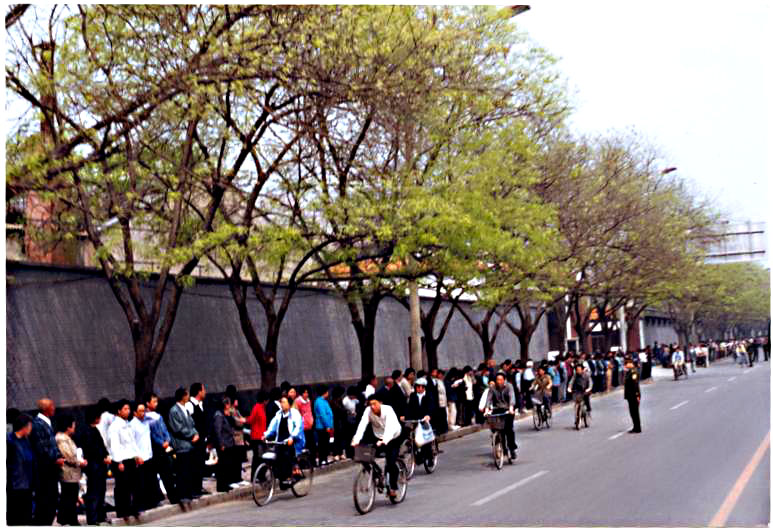 |
The above four pictures: The peaceful appeal of over 10,000 Falun Gong practitioners in Beijing on April 25, 1999.
Related article (English): http://www.clearwisdom.net/emh/articles/2001/4/24/6770.html
As Ms. C, who lives in the Haidian District of Beijing, recalls, "At 7:00 p.m. on April 24, some practitioners told me how the practitioners in Tianjin had been beaten and arrested. They said that some practitioners wanted to go to the Appeals Office of the State Council to report the situation, and those individuals who wanted to go could go. So, four or five practitioners and I took the bus and arrived at the north entrance of the State Council at 8:00 p.m. on the same day.
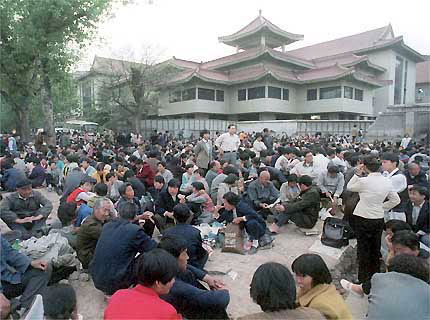
Mr. and Mrs. P from Beijing's Chaoyang District recalls, "By the morning of April 25, the west side of Fuyou Street was full of people; there was no one on the other side of the street [where the State Council is located]. Young practitioners stood in a row at the very front, leaving the sidewalk and the special sidewalk for the blind open. Behind the front row of practitioners all the way to the corner of the wall were seated practitioners. Everyone was very quiet. "
Practitioners kept coming from all directions and stood one after another along the pedestrians nearby. However, the traffic was not blocked. There were quite a few elderly people in their seventies and eighties in the crowd. There were pregnant women and mothers carrying their new-born babies. In order to reduce the time spent going to the washroom, many people only ate a small amount of food and drank little water. Some even did not drink at all. They simply seemed to "come from nowhere and then returned into nowhere" (according to the description from Clearwisdom Net).
On February 15, an article named "Remembering April 25th, 1999: Zhu Rongji Led Us inside Zhongnanhai" by Shi Caidong, a PhD student of the Chinese Academy of Sciences and a Falun Gong practitioner who joined in the peaceful appeal, reflected on the details of the appeal and meeting with the premier.
English version of the article:
http://www.clearwisdom.net/emh/articles/2004/3/10/45906.html
It was around 7 a.m. when I arrived at the north end of Fuyou Street on April 25. Practitioners had already filled up the two sides of Fuyou Street and nearby streets. Some stood there and some sat down, but they did not talk to passers-by. Some were holding books and reading. Even though there were a lot of people, they did not create a traffic jam, nor did they make any noise. Bikers on their way to work were pedaling by as usual. I crossed Xianmen Boulevard and entered the south side of the city. It was my first time there and I didn't even know where the gate was. I thought I would first circle around to see if I'd run into any practitioners I knew. So I walked south along the west side of Fuyou Street. Practitioners lined up neatly on both sides of the streets. Practitioners on the outside were standing and practitioners on the inside sat down, and were all reading the book Zhuan Falun. Judging from their clothing, I could tell that some were from the countryside and they looked sincere and kind. I didn't meet anyone I knew along my way, although I did see many young men reporting on the situation through walkie-talkies. They were probably plainclothes policemen.
While walking further down the street, I heard low but enthusiastic applause. I turned to take a look and saw Zhu Rongji a few dozen meters away walking from the gate across the street. (I had just passed the west gate of Zhongnanhai). Several of his staff members were following him. They walked toward practitioners who were across the gate. Practitioners who were sitting down stood up and applauded. Everyone was very happy and surprised to see Zhu Rongji come out to meet practitioners as soon as he arrived at his office. Everyone wanted to approach him to explain the situation. I walked back quickly and also tried to approach him from inside the crowd. At that moment, a practitioner reminded everyone to stay put and maintain good order.
Zhu Rongji had probably already learned about Falun Gong practitioners' coming to appeal. He asked us loudly, "What are you here for? Who told you to come here?" A lot of practitioners who stood in the front were from the countryside and most of them stayed silent.
"You have freedom of religion and belief!" he added.
"We are Falun Gong practitioners and we are here to explain the situation," some practitioners in the crowd replied.
"If you have any problem, you can send some representatives up here and I'll take you inside for a discussion." Zhu Rongji paused, and then said, "I can't possibly talk to so many of you!"
Zhu Rongji encouraged us to designate representatives to talk to him. However, we had all come spontaneously and most of us did not even know each other and had never thought about designating representatives. Since our practice is entirely voluntary, we just come to practice whenever we feel like it and if we don't have the time we just go about our own business. Nobody signs up for anything and nobody ever takes a headcount, let alone elects representatives.
"Do you have any representatives? Who among you are the spokespersons?" He again asked.
At that moment I walked up towards him and ended up about two meters from him. "Premier Zhu, I can go with you." I was the first one from the crowd who volunteered.
"Who else?" Zhu Rongji asked. "We cannot have too many people." Zhu Rongji pointed at the first three persons. In fact, we were not elected or designated representatives, but were spontaneous volunteers.
Zhu Rongji turned and led us toward the west gate of Zhongnanhai. As he walked, he raised his voice and asked us, "Didn't I already comment on the situation you guys reported?"
"We did not see it!" we replied in surprise.
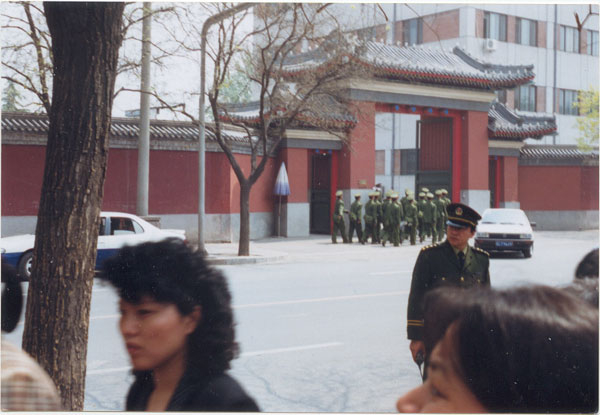
He probably realized something and changed the subject, "I'll get the director of the Appeals Office to talk to you. I'll get the Deputy Secretary to talk to you." He turned to his staff members and asked them to find the people he mentioned. At that time, we arrived at the Security Guards Post on the west gate of Zhongnanhai. The staff members signaled us to stop and took us to the left into a reception room while Zhu Rongji went into Zhongnanhai to work.
The Security Guards Post was very clean. On the desk against the west wall were telephones and a switchboard. There were several chairs in the room as well. Several young police guards were busy with their work. Soon after, four officials in their thirties and forties came in. One of them who was in his forties sat across me. According to Zhu Rongji, he was the person in charge of the Appeals Office. He said, "We are here on the Premier's request to try to understand the situation. You guys first give us your information." The three of us took turns telling them our names, work units, and phone numbers. Every one of them was taking notes. Only then did I learn the names of the other two practitioners.
One of the female practitioners was an employee of a computer company in Beijing University. She started by saying, "He Zhuoxiu published an article that slandered Falun Gong in an educational magazine in Tianjin"
The person in charge of the Appeal Office did not seem to understand and interrupted her, "Who?"
"He Zhuoxiu," we replied in unison.
"So it's just about He Zhuoxiu! [So what!?]" He said as he took notes dismissively. "It's He Zhuoxiu again!" Another official muttered.
"Tianjin Falun Gong practitioners went to the magazine to explain the true situation, however the police arrested more than forty practitioners. We hope that they can release them as soon as possible," the female practitioner added.
From the looks on their faces, some seemed to understand the situation. But the man in his forties didn't seem to understand. He turned to the young man by his side and seemed to check with him about the situation in Tianjin.
The female practitioner and another practitioner who had been laid off from his job said something to the effect of, "Falun Gong practices 'Truthfulness, Compassion, Tolerance.' We have personally benefited from the practice, so we told our friends and relatives. They also benefited from the practice after a while so they told their friends and relatives. It has been spreading from one person to another, from heart to heart. As a result, more and more people have started practicing Falun Gong. Now, in some areas, practitioners have had disruptions in their exercise practice. We hope that we can have a fair and lawful environment for our cultivation practice."
I reiterated the situation I had addressed in my previous letters, "Also, the book Zhuan Falun used to be published openly and publicly. But the government's News Publishing Bureau banned the publication of the book. So there are a lot of pirated editions circulated in society. We hope that you can give permission to allow open and public publication of Zhuan Falun."
The four officials took notes as they listened. The three of us took turns adding our own perspective to the conversation.
We also discussed the government's "Three NO's" policy about the qigong and human body science (i.e., no promotion, no arguments, and no attacks). Now that the government has stated this policy, government officials at different levels and the media should implement it.
During our discussions the middle-aged official seemed to realize that we were not designated representatives who had been prepared to negotiate. He probably did not know that we were randomly picked by Zhu Rongji. "Do you have anybody who is in charge that can act as a representative? Can you find two persons that are in charge?" He asked.
"I'll go look for veteran practitioners," I replied. There is nobody really in charge in Falun Dafa. Everyone follows the teachings to determine what he or she should do. We have personally benefited from the practice and want to be good people, so we insist on practicing Falun Gong. The officials were looking for persons in charge but I had no idea who that would be. All I could do was look for practitioners who had started practicing Falun Gong early on who might give them some more information.
He agreed and signaled a staff member to take me out to find somebody.
I went to practitioners across the west gate and asked if anybody had more knowledge of the situation. However, most of us did not know each other very well. I asked several practitioners when they started practicing Falun Gong. Eventually, I found somebody who started practicing Falun Gong in 1994 and we returned to the reception room at the west gate of Zhongnanhai. Before he could even explain, the middle-aged official interrupted him, "We'll report your situation to the State Department and leaders in the central government as soon as possible. When you leave, please tell every one to go home. Go home as soon as possible."
When we were leaving, I summed up our requests, "Mainly there are three issues we want to address: First, we hope that Tianjin police will release the Falun Gong practitioners as soon as possible. The second is to allow the open publication of Zhuan Falun. The third is to provide a fair and lawful environment to practice Falun Gong." I also gave them several copies of Zhuan Falun as gifts for the government leaders to read.
Later, it seemed that the message we conveyed was also what a lot of practitioners wanted to tell the government. On the same afternoon, supervisors from the State Department talked to practitioners from the Beijing Falun Dafa Association and they discussed similar issues.
 |
|  |
| 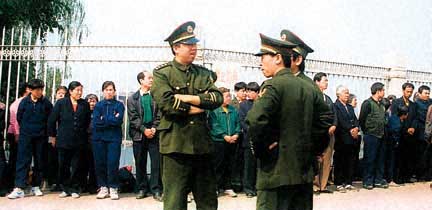 |
The above three pictures: Falun Gong practitioners waiting quietly for a just decision by Central Government officials on April 25, 1999.
By the evening, the detained Falun Gong practitioners were released in Tianjin according to instructions from the Central Government. The "4.25 appeal" successfully achieved an agreement and resulted in a satisfactory solution. The practitioners gathered outside Zhongnanhai began to leave quietly.
During the peaceful appeal of April 25, 1999, Falun Gong practitioners displayed their honesty, compassion, forbearance, and rationality. They not only earned the praise of a large number of onlookers and policemen on duty, but also got the attention of the high-ranking officials in China and the international community as well. At the same time, the open and prompt resolution to the incident by the Chinese government left the international community with a good impression. Media reports in many countries spoke highly of the incident and the peaceful resolution.
(To be continued)
(1) Item No. 27, Chapter Three of Administrative Regulations for Publications as issued by the State Council in 1997: When the content of published articles on newspaper and magazines is not true or fair, and is harmful to the rights and interests of citizens, lawful people, or other organizations, the harmed parties have the right to a correction or a defense. The relevant publishing units should publish the correction or defense in their latest issues of newspaper or magazine. Upon refusal of a correction or a defense, the harmed parties may file a lawsuit at the People's Court.