A new striking image from the infrared telescope shows a vibrant cloud called the Trifid Nebula dotted with glowing stellar "incubators." Tucked deep inside these incubators are rapidly growing embryonic stars, whose warmth Spitzer was able to see for the first time with its powerful heat-seeking eyes.
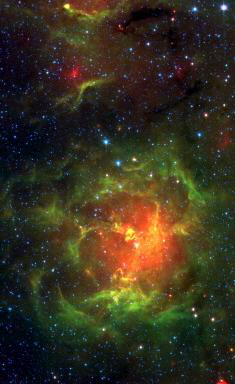
This image composite compares the well-known visible-light picture of the glowing Trifid Nebula (left panel) with infrared views from NASA's Spitzer Space Telescope (remaining three panels). The Trifid Nebula is a giant star-forming cloud of gas and dust located 5,400 light-years away in the constellation Sagittarius. Credit: NASA/JPL-Caltech/J. Rho (SSC/Caltech)
The Trifid Nebula is a giant star-forming cloud of gas and dust located 5,400 light-years away in the constellation Sagittarius. The Trifid Nebula is unique in that it is dominated by one massive central star, 300,000 years old. Radiation and winds emanating from the star have sculpted the Trifid cloud into its current cavernous shape.
Spitzer discovered 30 embryonic stars in the Trifid Nebula's four cores and dark clouds. Multiple embryos were found inside two massive cores, while a sole embryo was seen in each of the other two. This is one of the first times that clusters of embryos have been observed in single cores at this early stage of stellar development.
Spitzer also uncovered about 120 small baby stars buried inside the outer clouds of the nebula. These newborns were probably formed around the same time as the main massive star and are its smaller siblings.
Astronomers thought the ones in the Trifid Nebula were not yet ripe for stars. But, when Spitzer set its infrared eyes on all four cores, it found that they had already begun to develop warm stellar embryos.
Source: http://www.spaceflightnow.com/news/n0501/12incubators/