



Part 1: http://www.clearwisdom.net/emh/articles/2005/10/26/66230.html
Part 2: http://www.clearwisdom.net/emh/articles/2005/10/31/66204.html
Part 3: http://www.clearwisdom.net/emh/articles/2005/11/7/66594.html
(Clearwisdom.net) The authorities at the Chaoyanggou Forced Labor Camp in Changchun City have followed Jiang Zemin and his group of political villains and have employed extremely savage methods to persecute Falun Gong practitioners. In December 2000, the Jilin Province Party Committee and persons from the provincial government assigned the Chaoyanggou Forced Labor Camp to be the brainwashing base for Falun Gong practitioners in Jilin Province. They sent male Falun Gong practitioners arrested throughout Jilin Province, except for Baicheng and Yanbian, to this labor camp. Under instruction from the provincial 610 Office they carried out a systemic persecution of detained Falun Gong practitioners. It has been verified that at least 19 Falun Gong practitioners have been tortured to death and many practitioners have been injured and disabled through torture while incarcerated at the labor camp.
IV. Financial Deprivation
The lawless government officials and the police often extort money from Falun Gong practitioners. They lay off the practitioners, withhold their bonuses and salary, extort money and ransack their homes. Financial deprivation of Falun Gong practitioners held at Chaoyanggou Forced Labor Camp is even more outrageous.
"Pulling Money Out of Thin Air"
In late 2001, the labor camp made a rule that each detainee must pay 100 yuan, claiming that the money is used to buy military-style bedding, which the detainee will use and which they can take with them upon release. They said that if the labor camp keeps the bedding, the detainee will get 100 yuan back. The reality is, the detainees are not allowed to use the bedding and are forced to fold it in military style and put it on the bed each morning to maintain the uniformity of the room. Every night the bedding was stored in an appointed corner to maintain its shape. Each bedding set costs 70 yuan at most, which means the labor camp authorities make at least 30 yuan profit from each bedding set, or a total of 15,000 yuan from 500 bedding sets for the whole labor camp. Moreover, the detainees are not allowed to take the bedding with them when they leave, and they never receive a refund. The labor camp keeps the bedding and resells them to newly arrived detainees, again charging 100 yuan for each bedding set.
The labor camp was moved to a new location next to the old site. The old site was "rented" to underground factories that are not licensed and don't pay any taxes. The labor camp forces detainees to do slave labor for these factories and makes money off them. Quite likely, labor camp authorities or their acquaintances are the owners of these factories. The labor camp colludes with the police and factory owners to force Falun Gong practitioners to work in these factories, folding paper toilet seat covers and working with leather. The print shop exploits the highest number of Falun Gong practitioners. The factory owners are eager to take advantage of this cheap labor. The labor camp authorities collect all of the workers' wages.
There is a small canteen in labor camp. It sells nothing but pirated, expired and low quality products priced very high.
Blatant Extortion
The Trial Implementation Methods for Reeducation through Labor and other related laws state that, "Labor camp detainees enjoy the sanctity of personal and property rights, and corporal punishment of persons under labor reeducation is forbidden." These rules, however, are nonexistent at the labor camp, as the guards treat the detainees like working cattle, whom they can insult and hit at will. If a detainee bribes the guards, he will receive different treatment. If he buys a box of cigarettes for a guard, he will be treated humanely for one day, but the guard will turn on him if another box of cigarettes or other "gifts" are not offered the next day.
The labor camp authorities have the following price schedule for sentence reduction: detainees can buy a one-month sentence reduction for 1,000 yuan; a 20-day sentence reduction for 600 yuan, and for 300 yuan, they can be excused from doing work. The sentence reductions at the No. 1 and No. 2 Divisions didn't sell; although each division has two quotas a year, each one is a three-month sentence reduction, because the detainees in those two divisions don't have the money to pay any bribes. In the end, they offered sentence reductions for a price of 1,000 yuan, and the division head pocketed the money.
Camp director Wang Yanwei did not do anything positive for the detainees, even after taking money from them. In 2001 he extorted over 20,000 yuan from a detainee. Each detainee is required to pay 100 yuan on arrival. They are told that the money will be returned when they leave the labor camp. Guo, a convicted thief, went to ask for his money on the day of his release. The guard said to him, "So, you don't want to leave here then?" They didn't release him until almost closing time in the afternoon. Guo again went to the guard who asked him, "Do you still want your money back?" Guo answered, "No." He was immediately released.
In each division there is one detainee assigned to answer to the division head and the guards. To obtain this coveted position, this detainee must pay 1,000 yuan and he must be very clever and obedient. The class and cell leaders also have people waiting on them, as there is a strict hierarchy at the labor camp. Sometimes the guards don't want to go to the dining room to eat, so their "servants" collect sausages and canned food from other detainees. They punish other detainees if they refuse to give up their food. They even take instant noodles and cigarettes from the detainees. In the evening, the guards on duty drink and gamble and order the detainee on duty to keep a lookout for their superiors for them. Once the superior caught the guards gambling; afterwards the detainee lookout on duty was savagely beaten and humiliated.
In late 2003, the guards extended the sentence of determined Falun Gong practitioners. After the additional sentence had expired, the labor camp authorities would no longer report to the National Security Bureau or the 610 Office and would extort large amounts of "guarantee money" from the practitioners, ranging from 3,000 yuan to over 10,000 yuan before they would release the practitioners. Liu Aiguo, head of the No. 7 Division, forced the detainees to curse Dafa and Master each day; those who refused would be transferred to another division, while those who gave him money would be allowed to stay. He not only persecuted the practitioners but also persecuted their families. Practitioner Zang Cheng's sister sells flowers and is very poor. The labor camp sent Liu Aiguo to buy flowers. Liu Aiguo went to Zang Cheng's family, lied to them saying that Zang Cheng would be released ahead of time and extorted over 500 yuan from them. There are countless other extortion cases at the labor camp.
Forced Labor
All of the practitioners illegally held at Chaoyanggou Labor Camp are forced to do slave labor, including on holidays and weekends. They do not receive a penny for their toil. This is a violation of Decision of the State Council Regarding the Question of Reeducation Through Labor of 1957. In April 2001, the labor camp authorities forced the practitioners to do dangerous and harmful work. Detainees from Division 2 worked at a flooring factory, where they inhaled lots of plastics fumes without any protection. The practitioners did not have enough food and were forced to do long-term labor. When they loaded and unloaded PVC raw material, each person had to carry bags weighing about 50 kg [110 lbs] and lay the bags in a neat and orderly pile. The practitioners sweated profusely and panted heavily, while the guards and head inmates screamed at them.
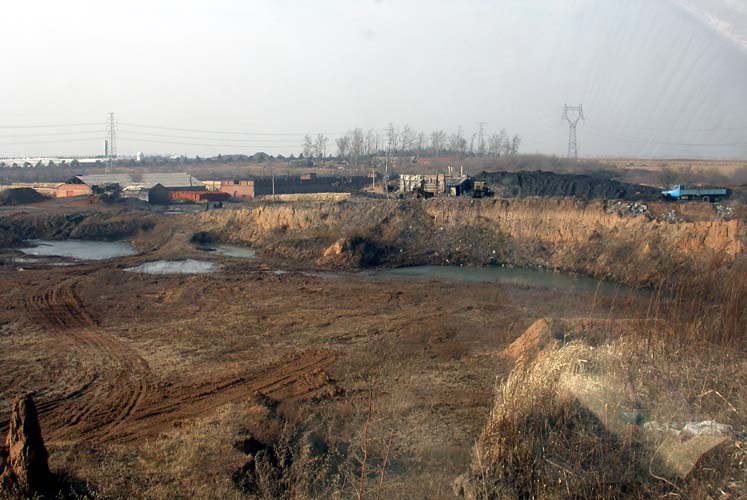

Ditch in front of Chaoyanggou Forced Labor Camp brick factory.
Between 2001 and 2002, the Chaoyanggou Forced Labor Camp authorities compelled Falun Gong practitioners to dig and carry soil to provide raw material for the brick factory. Four groups, each consisting of seven people, were put to work. One person in each group had to push the one-ton cart while other people dug the earth. One cart carries about 1.5 ton of soil; at the quickest, the cart can make a round trip in one minute. About 800 carts of soil are transported each day. A giant hole was left by Falun Gong practitioners and inmates who were forced to dig the soil.
Some practitioners have been reduced to skin and bones. The work environment around the brick factory outside the No. 4 Division was terrible. The so-called factory is an open field, and a dozen piles of soil provide the raw materials for the factory. There were sieves placed around the soil piles and people sifted the soil. They would be cursed and beaten if they were slow. Some people pushed carts with soil and some pushed carts with hollow bricks. They had to run while pushing the carts. The practitioners were forced to work for ten hours and run about 10,000 meters [about 6.2 miles] a day. The intensity of work far exceeds an average person's physical tolerance. The equipment is outmoded and the sweltering heat added to the suffering. Soil particles and dust floated in the air. The practitioners' eyelids, noses, ears and bodies were covered in soil. The guards and inmates sarcastically called this scene "desert storm."
Due to long-term exposure to heat, the practitioners' skin turned black; the skin on their back cracked open and emitted stabbing pain. Their hands were covered with calluses that cracked open, so painful that they could not touch water. Their families were heartbroken when they met on visiting days. The guards often threatened the practitioners' families and forced them to pressure the practitioners to make them give up their belief in Falun Dafa.
The No. 6 Division mostly engaged in agricultural work. The detainees almost never had a break. They worked in the fields, rain or shine. On top of slave labor, Falun Gong practitioners also had to endure torture, including the water dungeon, severe and hunger and scabies.
The labor camp authorities forced the practitioners to work as many as 12 hours a day as punishment under the persecution. Division 3 took paper-processing work, making a paper liner that is placed on toilet seats. This product is exported to Southeast Asia or to Western countries. To make more money, there are no breaks, including weekends, for the workers, aside from the days when the raw material ran out or when the equipment broke down. When the workload increased, even the workers' lunch break was taken away, and they were forced to work all day long, except for quickly eating three meals. Because one has to keep count when folding the paper liners, the practitioners feel dizzy and weak after a day of work.
The intensity of labor continuously increased, and most of the time the guards pressured, threatened or cursed the practitioners. In order to increase the number of products made, the practitioners were forced to work during state holidays including the seven-day National Holiday break starting from October 1. On October 2, officials from Changchun City Judicial Bureau came to inspect work. The guards said to the practitioners, "If the officials ask why you are working during the holidays you must answer, 'We volunteered.'"
V. Other Abuses
The Chaoyanggou Labor Camp authorities wanted the labor camp to be promoted to a bureau-level labor camp by the end of 2002. The authorities therefore proposed to take all measures to ensure that this promotion could be obtained. Regulating the administration is an essential criterion for promotion, but in fact the administration at this labor camp is chaotic and lawless, so the authorities made false records. For example, the detainees' case file is the main component of administration work/record keeping in the labor camp. To assure a promotion, the labor camp authorities organized a group of educated detainees to alter all of the existing case files. Starting from the day the detainee entered the labor camp, the authorities ordered that details be changed or rewritten to present the labor camp in a favorable light. The officials and assigned inmates worked around the clock to embellish the records and make them look good.
The labor camp dining hall cooked meat and chicken when officials came to inspect. When the officials left, the same vegetable and carrot soup would return, yet the officially published menu would still include a sumptuous meal. Detainees are required to memorize the menu in order to "correctly" answer the inspection officials, or they would receive a beating afterwards. Once the inspecting officials saw a beating take place on a monitor screen. They asked camp head Wang Yanwei and official Long, "What's going on here?" Wang Yanwei and Long answered, "They are just playing."
The labor camp also established an Education Section and a Collaborators' Group to brainwash determined Falun Gong practitioners. When TV reporters came to videotape or someone came to visit the labor camp, the authorities would assign certain inmates or collaborators and teach them a set of answers they would give to the visitors while promising them sentence reduction. They ordered the inmates and collaborators to pose as Falun Gong practitioners to deceive the visitors.
The labor camp strictly forbids Falun Gong practitioners from contacting the outside. They withheld and opened practitioners' letters and packages at will, and didn't allow the practitioners any legal rights. They are limited to a few items of food and clothing they can receive from their families, and sometimes family visits are not allowed.
During the 2005 Chinese New Year, a leadership transfer took place at the labor camp. Wang Xiaoming became the new director of the labor camp. He proposed "Six Zeroes" during his New Year's speech, including, "zero death" and "zero escape." The No. 4 Division, the Strictly Controlled Division and the former No. 2 Division led this Six Zeroes movement. Political head Chen Zhigui and guard Li Jun were most vicious. They used the interrogation room as a torture chamber to torment and abuse Falun Gong practitioners. Between March 30, 2005 and May 17, 2005, 18 Falun Gong practitioners were tortured. Each day the electric batons and the practitioners' screaming could be heard. Each practitioner walked into the room but had to be carried out. They did not spare practitioners in poor health, including practitioner Shao Zhenkun who was diagnosed with pleurisy and pulmonary edema, or excessive fluid in his chest that weighed about 2 kg [4.4 lbs], and practitioner Sun Changping who had a protruded spinal disc and needed help walking. They were handcuffed and hung up and were tortured day and night. Practitioners who gave up Falun Dafa and later returned to Dafa practice were tortured even more severely; practitioners Xiao Ming, Zhao Xianjun and Xu Qingwu were tortured until their bodies were covered in wounds.
Chaoyanggou Labor Camp is nothing more than a concentration camp where Falun Gong practitioners are subjected to savage abuse.