(Clearwisdom.net) On April 25, 1999, Over 10,000 Falun Gong practitioners gathered near Fuyou Street in Beijing. They were quiet and orderly, waiting patiently. The police officers dispatched to maintain order were relaxed and chatted among themselves.
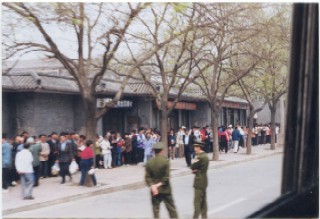 Police on duty talk among themselves (please note, the wall behind the practitioners is not the Red Wall of the Forbidden City). |
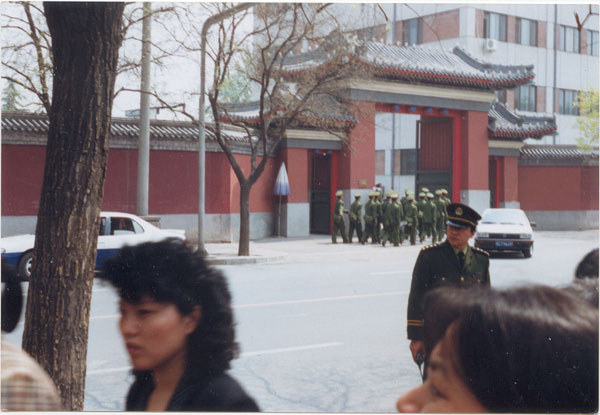 Across the street from the practitioners is the western entrance of the Zhongnanhai Compound (here the Red Wall of the Forbidden City is visible). |
Xianmen Street, next to Zhongnanhai, is the location of the State Council's Appeals Office. The appeals system is supposed to serve as a channel for the government to hear the people's complaints. This is the first time in Chinese history that over 10,000 people appealed at the same time to the highest appeals office.
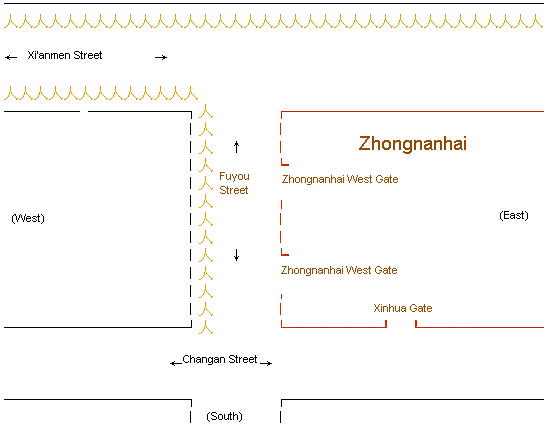
Illustration of how the practitioners who came to appeal were distributed (the character ^ shows the position of the crowd)
This large-scale, peaceful civil appeal was called The "April 25 Incident." Later, Falun Gong, a qigong cultivation method rooted in traditional Chinese culture, quickly became the focus of the world press through media reports within and outside of China - although in the following years the official Chinese media and the foreign media had distinctly different opinions regarding Falun Gong. From a CCTV videotape we can see that Zhongnanhai's western entrance to the Red Wall of the Forbidden City is across the street from the appealing crowd. We all know that the front entrance of Zhongnanhai is the Xinhua Gate on Changan Street. In fact, the practitioners didn't gather in Changan Street on April 25. Most practitioners were in Fuyou Street and Xianmen Street; no one gathered at the side of the Red Wall of Zhongnanhai.
From the CCTV videotape we can see the crowd does not show agitation, didn't shout slogans and didn't use banners that are common in protests. Obviously, the practitioners didn't "besiege" Zhongnanhai, nor did they attack the government.
Why did the 10,000 practitioners hold a peaceful appeal?
1. Quiet Before the Storm
Falun Gong, introduced to the public in 1992, emphasizes Truth-Compassion-Forbearance as its guiding core principles. Because of its health benefits, the simple exercises and free instruction, many Chinese people embraced Falun Gong. The rapid increase in the numbers of Falun Gong practitioners quickly attracted the attention of high-level officials in the Chinese Communist Party (CCP). Some political opportunists took it as an opportunity to earn political credits.
On June 17, 1996, the Guangming Daily published a commentary that labeled the book Zhuan Falun one of the top ten bestsellers in Beijing. However, an article in the Beijing Youth newspaper labeled Falun Gong as bogus science. One month later, the General Administration of the Press and Publication, controlled by the Propaganda Department, banned the publication of Falun Gong books, claiming that they "promoted superstition."
Since 1997, Luo Gan, the secretary of the Politics and Law Committee of the CCP Central Committee ordered the police system to secretly investigate Falun Gong, in an attempt to find fault with Falun Gong and ban it. Luo Gan's brother-in-law He Zuoxiu and others continually penned articles to attack Falun Gong that were published throughout the country.
In early 1997, Luo Gan ordered the Ministry of Public Security to conduct a nationwide investigation and to collect evidence in an attempt to condemn Falun Gong as "an evil cult." After thorough investigations, the local police departments throughout the country all reported, "there is no problem found with Falun Gong." The investigation thus ended.
In July 1998, the 1st Bureau of the Chinese Ministry of Public Security issued Document [1998] No. 555, "Notice of the Investigation of Falun Gong," which first claimed that Falun Gong was an "evil cult." The Ministry of Public Security carried out a series of investigations of Falun Gong based on the premise, "find as guilty first, collect evidence after." The local police and political system conducted thorough investigations. They were surprised that they could not find any incriminating evidence against Falun Gong anywhere in the country. These two investigations, however, brought about severe consequences.
For example, in 1998, the Chaoyang City Police Department in Liaoning Province issued document No. 37, "Notice of Banning Illegal Falun Gong Activities" to local police departments. As a result, some Falun Gong practice site assistants were fined several times for a total of over 4,000 yuan. Some practitioners didn't receive any receipt or received only a blank note for the fine. More than 40 practitioners went to the Ministry of Public Security in Beijing to appeal against the local police action; more than 1,000 practitioners wrote and signed a joint appeal against the Chaoyang Police Department's violation of citizen's legal rights.
On July 21, 1998, the 1st Bureau of the Ministry of Public Security again distributed a notice to all the police departments in the country, which again triggered antagonistic actions against Falun Gong practitioners on the part of local police officers in Xinjiang Autonomous Region, Heilongjiang Province, Hebei Province, Fujian Province and other places. They forcibly dispersed practitioners during group exercise practice, ransacked the practitioners' houses, and confiscated their personal property. Their actions caused great discord among the population.
2. Tianjin Incident
On April 11, 1999, He Zuoxiu printed another article in a national magazine published by the Tianjin Teacher's College in which he implied that, "Falun Gong would cause psychosis and would destroy China like the Boxer Rebellion."
The groundless accusations and particularly the linking of Falun Gong to the Boxer Rebellion made the practitioners feel that if the facts were not clarified, not only would the practitioners' legal right to practice be threatened, but also scheming politicians would drag practitioners into political struggles. Out of their sense of conscience, the practitioners went to the Tianjin Teacher's College to clarify the facts to the magazine editors. At first, the editors met with the practitioners and said they were willing to publish a correction of the untruthful article, but they suddenly changed their attitude the next day and refused to make the correction.
More and more practitioners gathered outside the editorial department, hoping to clarify the truth of Falun Gong with their firsthand experiences. On April 23 and April 24, the Tianjin Public Security Bureau dispatched 300 riot police who used violence and excessive force to disperse Falun Gong practitioners, injuring some who had gone to the Tianjin Teacher's College to clarify the truth about Falun Gong. The police arrested 45 Falun Gong practitioners. Tianjin City government officials told the practitioners that the Tianjin City government could not deal with this issue and that the practitioners had to appeal to the central government in Beijing. When the practitioners requested the release of their fellow practitioners, the Tianjin City government representatives told them that the Ministry of Public Security was involved, and the practitioners would not be released without permission from Beijing. The Tianjin police suggested to the practitioners, "You should go to Beijing; only by going to Beijing will you solve this problem!"
3. Peaceful Appeal
The unusual attitude of the Tianjin City government and the ruthlessness of the police made it clear that they were acting under pressure from the central government. Nevertheless, the practitioners believed that it is not wrong to be a good person according to Truth-Compassion-Forbearance; they had witnessed firsthand that Falun Dafa is good. With trust in the government and the hope of abolishing the apparent misunderstandings, 10,000 Falun Gong practitioners voluntarily went to Beijing and petitioned at the State Council's Appeals Office near Zhongnanhai on April 25, 1999.
Premier Zhu Rongji met with several representative practitioners the same day.
According to practitioner Gao Dawei, a former member of the Guangdong Province Political Consultant Conference, "At about 10:00 a.m., Premier Zhu Rongji went to the airport to see off some foreign guests. He noticed many practitioners, so he sent someone to see what was going on. He asked his staff to tell us that he would meet with our representatives after he saw the guests off and learned the details [of the appeal]. The representative practitioners made three requests to Premier Zhu: "First, release all illegally arrested practitioners in Tianjin; second, provide a legal and reasonable cultivation environment for Falun Gong practitioners; third, lift the ban on the publication of Falun Gong books."
Premier Zhu Rongji quickly ordered the Tianjin City Police Department to release the practitioners, and he reiterated the government's policy of no government involvement in qigong practice.
Yang Qing, a practitioner from the practice site at Tsinghua University related, "Around 9:00 p.m. in the evening of April 25, the representative practitioners came back and told us we could appeal at the local appeal offices, and the State Council would handle our requests. We were satisfied when we heard this."
The practitioners left quietly at 10:00 p.m. The whole process was quiet, harmonious and orderly.
The "April 25 Incident" created the historical precedent in which a crisis was solved between the Chinese government and the citizens through peaceful dialogue. The international media highly praised the handling of the incident and thought it was a milestone marking the Chinese government's progress toward democracy. Many people held new hope for the Chinese government. People also noticed that Falun Gong, a cultivation group consisting of ordinary members of society, was very extraordinary.
Professor Feng Lili, who was working at Scripps Research Institute in San Diego at the time, was surprised by the peacefulness, rationality and courage displayed by the practitioners during the "April 25 Incident." She developed an interest in Falun Gong and eventually became a practitioner. When talking about her feelings upon hearing the news of the appeal, she said, "They are so pure! They are full of hope for the country. They believed they could talk to a government they trust; that they could place their heart and faith in the government. A country should be happy to have such a group of people! It should embrace them and reward them, because they believe in the government."
4. Turning of the Tide
And yet, the person in the highest-power position didn't trust this group of people who had so much faith in the government.
On the evening of April 25, Jiang Zemin, in his capacity as Secretary-General of the CCP Central Committee, wrote letters to the members of the Standing Committee of the Politburo and other government officials. Following this, he frequently asserted pressure on the Politburo, the Central Secretarial Committee and the Central Military Commission and circulated his speeches attacking Falun Gong as important documents to be circulated within the CCP. On June 10, under Jiang Zemin's personal control, the "CCP Central Committee Leadership Group of Handling the Issue of Falun Gong" was established; it was the notorious 610 Office. The name was later changed to "Anti-evil Cult Organization Office" to evade the people's attention.
By then, the persecution, started by Jiang Zemin himself with the goal to completely eliminate Falun Gong, was thoroughly in place.
Why does Jiang Zemin want to persecute Falun Gong? Rational-minded people find this incredulous.
In fact, as the highest-placed Chinese ruler who wields power over the military, the Party and the political system, Jiang Zemin didn't swoop into office because of his abilities or his experience, but because of political opportunism. He gained favor within the Party through his hard-line suppression of the pro-democracy activists during the 1989 Tiananmen Square Massacre. He realized clearly after he took office, that many high-ranking officials with greater experience and abilities - within the Party, the military and the government - didn't hold him in high regard. His insecurity and thirst for power made him extremely jealous and fearful of Premier Zhu Rongji who had won international recognition for his handling of the "April 25 Incident" and fearful of Falun Gong and Falun Gong's founder, who was widely popular in China.
CNN Senior China Analyst Willy Wo-Lap Lam pointed out in his article, "CNN: China's [group] suppression carries a high price;" "It is no secret that several Politburo members thought the president had used the wrong tactics..." "'By unleashing a Mao-style movement, Jiang is forcing senior cadres to pledge allegiance to his line,' said a Party veteran, 'This will boost Jiang's authority...Jiang might want a public show of support for himself if only because the Politburo had divergent views on what to do with the Falun Gong.'"
Without any convincing evidence, at the Politburo, Jiang Zemin described Falun Gong as a political organization supported by "overseas enemy forces," thereby giving special significance for his personal decision to persecute Falun Gong. Fully driving the persecution, Jiang Zemin believed that he could quickly eradicate Falun Gong. All-out persecution orders were issued against Falun Gong to all levels of government, as a political assignment. After these classified documents were handed down, a group of good citizens were thus deprived of their rights and freedom endowed by the constitution, and the country started to "respond to" and "support" the government's decision. For a generation of Chinese people over 50 years of age, this persecution reopened the deep scars imbedded in the nation of China, scars that had just barely begun to heal from the impact of so many damaging political movements.