University City Review: Philadelphia Forum on Organ Harvesting in China
Special to the U.C. Review
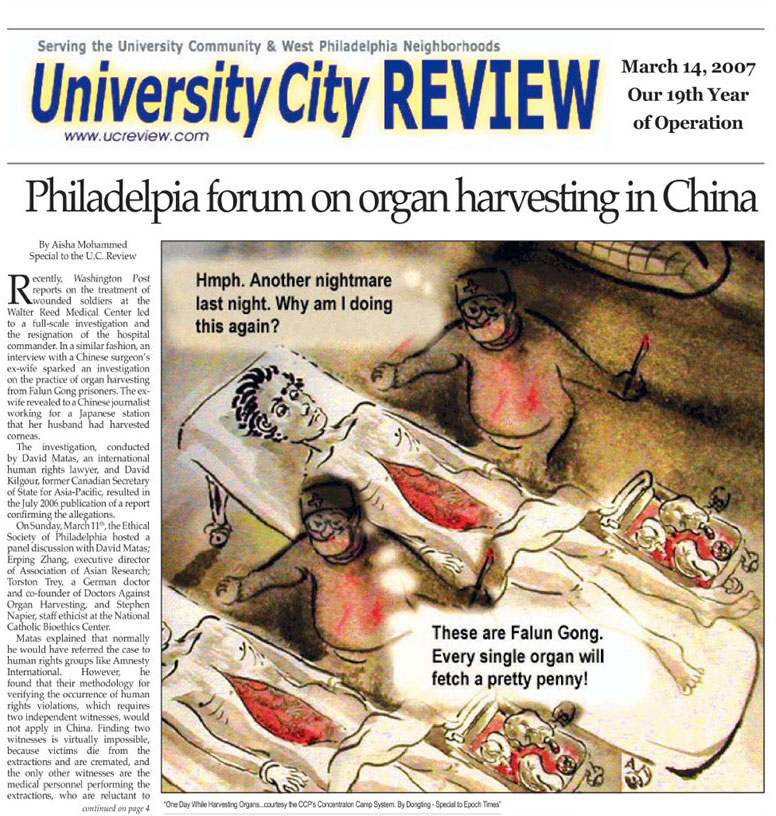

Recently, a Washington Post report on the treatment of wounded soldiers at the Walter Reed Medical Center led to a full-scale investigation and the resignation of the hospital commander. In a similar fashion, an interview with a Chinese surgeons' ex-wife sparked an investigation of the practice of organ harvesting from Falun Gong prisoners. The ex-wife revealed to a Chinese journalist working for a Japanese station that her husband had harvested corneas.
The investigation, concluded by David Matas, an international human rights lawyer, and David Kilgour, former Canadian Secretary of State for Asia-Pacific, resulted in the July 2006 publication of a report confirming the allegations.
On Sunday, March 11, the Ethical Society of Philadelphia hosted a panel discussion with David Matas; Erping Zhang, executive director of the Association of Asian Research; Torston Trey, a German doctor and co-founder of Doctors Against Organ Harvesting; and Stephen Napier, staff ethicist at the National Catholic Bioethics Center.
Matas explained that normally he would have referred the case to human rights groups like Amnesty International. However, he found that their methodology for verifying the occurrence of human rights violations, which requires two independent witnesses, would not apply in China. Finding two witnesses is virtually impossible, because victims die from the extractions and are cremated, and the only other witnesses are the medical personnel performing the extractions, who are reluctant to testify for obvious reasons.
To overcome this situation, Matas used the methodology of establishing evidentiary trails, and he was able to establish 18 of them. He grouped these into three categories: general considerations, organ harvesting and Falun Gong. General considerations that point to this appalling practice are that hospitals are under funded, and depend on the revenue generated from organ transplants to keep their doors open. One transplant center in Shenyang City lists organ prices on its website, with a liver costing $130,000 U.S. The military too lacks sufficient funds and sells organs to raise funds for weapons.
As for evidentiary trails related to organ harvesting, Chinese doctors perform more transplants than any other country, yet China has no organized system for organ donation. The Chinese government admits that all organs come from executed prisoners, but even this, apart from the fact that the validity of prisoner's consent is questionable, does not account for the large number of organs available. China executes approximately 2,000 prisoners a year, yet doctors perform at least 10,000 transplants each year.
Torsten Trey believes that these additional organs are harvested from live prisoners, specifically the Falun Gong, who are routinely vilified, imprisoned and tortured for their spiritual beliefs. At the World Transplant Conference, he asked a Chinese surgeon where the extra organs came from. The surgeon told him to ask the Falun Gong practitioner protesting outside.
Other evidentiary trails that point to organ harvesting are that donors wait for patients, rather than patient-waiting-for-donors, which is the usual case. In other words, once a patient needs an organ, a prisoner is killed in order to provide that organ. This, along with the extremely short waiting time, one to two weeks, as compared to three to four years in other countries all support organ-harvesting allegations by Falun Gong practitioners.
As Matas discovered in his research, prisoners identified as Falun Gong are routinely given blood tests, and Falun Gong prisoners are also targeted for donations because they tend to be healthier, due to their exercise-based spiritual practice.
Erping Zhang explained why Falun Gong practitioners, in spite of their pacifist ideology are persecuted in China. When the practice was first introduced in 1992, the government endorsed it as a cost-cutting measure, because the health benefits of the exercises were calculated to save 1,000 yuan per person per year, adding up to billions of yuans.
In a few years, the practice grew exponentially, with the over 70 million followers, outnumbering the 60 million membership of the Communist Party. Besides the large numbers, the main issue with Falun Gong is that it is based on ancient Chinese traditions, which are in opposition to the western ideology of Communism.
In 1998[1999], the government began cracking down on practitioners, and incidentally, the number of transplant operations increased along with the numbers of Falun Gong practitioners imprisoned. In 1999, there were 33 transplants at one hospital. In 2004, the number had shot up to 1601.
Zhang pointed out the complicity of not only medical personnel in China, but also of American sinologists. He found that while researchers are willing to take on issues of trade and economic policy, most are reluctant to delve into human rights issues, because they fear losing their Chinese visas.
Also complicit in organ harvesting are pharmaceutical companies. Trey explained that approximately 1,000 Chinese doctors registered for the World Transplant Conference, yet only about 200 attended. The rest, he was told used the conference to obtain visas in order to meet with pharmaceutical companies that produce drugs to prevent organ rejection. Due to the high number of organ transplants, China is one of the biggest markets for anti-rejection drugs.
Napier provided an ethical framework for organ procurement, and also suggested that one way to address the problem is to promote ideological change. Citing the failure to value individual human life as the major factor enabling non-consensual organ harvesting, he suggested an exchange program where Chinese doctors study in the U.S. and learn the value of human life.
A Chinese physician present in the audience questioned the effectiveness of the strategy. Admitting that she did not value human life as a doctor in China, she said that her perspective completely changed once she came to work and study in Philadelphia. However, a physician in China reminded her that the lack of respect for individual human life is endemic to the medical system, and once doctors return to China, it will not be long before they slip back into old ways of thinking.
Trey suggested cutting down the demand and preventing "transplant tourism". He pointed out that in Germany, doctors are forbidden to provide after-care to patients who procure organs in other countries. While this may seem harsh, it does prevent states from facilitating the practice.
Matas also suggested that concerned citizens bring the ethical issues to the attention of local medical personnel. This suggestion is especially relevant to Americans, as a Chinese doctor in the audience pointed out that many American doctors travel to China to do transplants, and there is a lot of cooperation between the two countries in the area of transplants.