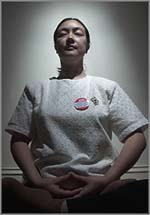
Imprisoned for her beliefs and forced to make toys for a multinational company ... Jennifer Zeng meditates in Sydney. Photo: Andrew Taylor
December 28, 2001
Brightly decorated stores stuffed with Christmas toys have brought back painful memories for Jennifer Zeng.
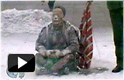
As she waits in Sydney for her refugee status to be assessed, the 35-year-old Falun Gong practitioner recalls her 12-month imprisonment in Beijing's Xin'an Labour Camp, where she says beatings, electric shocks and sleep deprivation were all part of the [Jiang Zemin's] Government's re-education program for those convicted of belonging to the outlawed meditation [group].
And stamped indelibly on her brain are the faces of 100,000 long-eared, buck-toothed toy rabbits, bearing the Nestle brand.
"We were told that the money received for each rabbit was the equivalent of about six Australian cents," says Ms Zeng. "The labour camp took it all. We received nothing."
Ms Zeng and about 130 other prisoners were forced to begin work each day at 5:30am and continue until early the next day, seven days a week.
The prisoners were not permitted to sleep for more than three or four hours between shifts, she says.
Ms Zeng is calling for an independent investigation into the use of unpaid prison labour from China's re-education camps.
Amnesty International says it has since catalogued a pattern of arbitrary arrest, detention without trial, and torture of Falun Gong practitioners, which has resulted in more than 250 deaths in police custody.
A spokesman from Nestle's Australian office said he was unable to comment on Ms Zeng's allegations and forwarded the Herald's questions to the company's head office in Switzerland. Nestle subsequently released a statement to the Herald, confirming that the company placed an order with an established Beijing-based toy manufacturer, Beijing MiQi Toys Co Ltd, for 110,000 plush rabbits for a Nesquik promotion early this year.
According to Nestle's head office, however, there is no evidence linking forced labour with Nestle's business dealings in China, where the company employs about 8000 workers in 18 factories across the country.
"In line with the Nestle Corporate Business Principles, Nestle does not buy products or materials from companies or institutions that use forced labour or involuntary prison labour," the statement said.
Ms Zeng has completed a detailed description of the toys she says Falun Gong prisoners were forced to make under inhumane conditions - toys she subsequently identified on several Nestle Web sites.
"I wish to ask related organisations to conduct independent investigations into the matter and prove to the world that Chinese labour camps force people to produce export products."
http://www.smh.com.au/news/0112/28/national/national19.html
Category: Falun Dafa in the Media