


2003-03-20
(Clearwisdom.net)
|
|
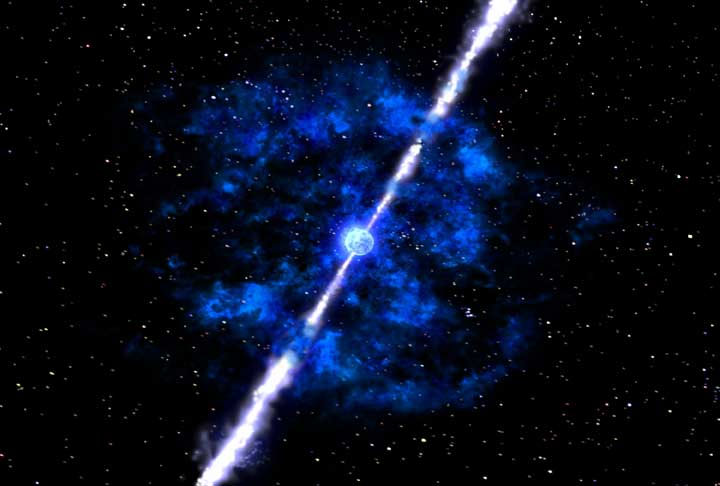
Scientists arriving on the scene of a gamma-ray burst just moments after the explosion, have witnessed the death of a gigantic star and the birth of something monstrous in its place, quite possibly a brand new, spinning black hole.
The burst observation, featured in the March 20 issue of Nature, is the most detailed to date. The observation confirms that gamma-ray bursts announce the demise of the most massive stars in the universe, a theory called the collapsar model. NASA's High-Energy Transient Explorer (HETE), ground-based robotic telescopes, and fast-thinking researchers around the globe, made the prompt observation possible.
"This stunning observation places us in the fiery throes of a star explosion, peering through the debris at a newly formed black hole within," said Dr. Anne Kinney, NASA director for astronomy and physics, Headquarters, Washington.
"If a gamma-ray burst is the birth cry of a black hole, then the HETE satellite has just allowed us into the delivery room," said Dr. Derek Fox of the California Institute of Technology in Pasadena, Calif., the lead author of the Nature paper.
Gamma-ray bursts shine hundreds of times brighter than a supernova, or as bright as a million trillion suns. The mysterious bursts are common, yet random and fleeting. The gamma-ray portion of a burst typically lasts from a few milliseconds to 100 seconds. An afterglow, caused by shock waves from the explosion sweeping up matter and ramming this into the region around the burst, can linger for days or weeks in lower-energy forms of light, such as X rays or visible light.
A gamma-ray burst, named GRB021004, appeared on October 4, 2002, at 8:06 a.m. EDT. Wasting no time, HETE spotted the burst, nailed down a location, and notified observers worldwide within a few seconds, while the gamma rays were still pouring in. First on the scene was the Automated Response Telescope (ART) in Wako, Japan, observing the region just 193 seconds after the burst.
Fox pinpointed the afterglow shortly after this from images captured by a telescope on Mt. Palomar, near San Diego. Then the race was on, as scientists, using more than 50 telescopes, in California, across the Pacific, Australia, Asia, and Europe zoomed in on the afterglow before the approaching sunrise.
Scientists arrived on the scene of GRB021004 early enough to witness an entirely new phenomenon: the ongoing energizing of the burst afterglow for more than half an hour after the burst. This power must have been provided by whatever object produced the gamma-ray burst itself.
"Gamma-ray bursts must be many times more times powerful than we previously thought," said Dr. George Ricker of the Massachusetts Institute of Technology (MIT), Cambridge, Mass., principal investigator for the HETE mission. "The gamma-ray portion of the burst is perhaps just the tip of the iceberg," he said.
These findings support the collapsar model, where the core of a massive star collapses into a black hole. The black hole's spin or magnetic fields may be acting like a slingshot, flinging material into the surrounding debris. Scientists calculated that GRB021004 originated from a star 15 times more massive than the Earth's sun.
[...]
http://www.sciencedaily.com/releases/2003/03/030320075124.htm
Views expressed in this article represent the author's own opinions or understandings. All content published on this website are copyrighted by Minghui.org. Minghui will produce compilations of its online content regularly and on special occasions.
Category: Perspective