Senior Science Writer
02 April 2003
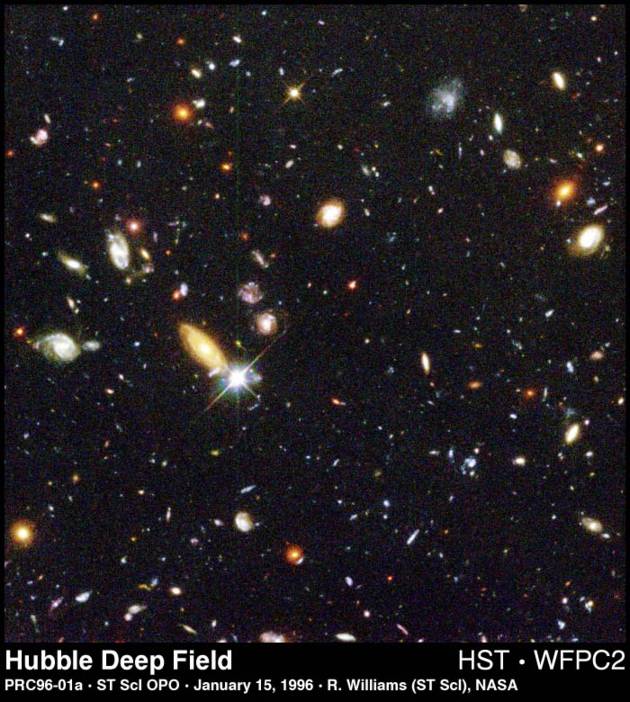 |
All too clear? According to two new studies, Hubble should not be able to snap pictures as sharp as this 1996 image, part of the Deep Field project that discovered hundreds galaxies billions of light-years away.
Clarity is what astronomers and the public have come to expect from the Hubble Space Telescope. But the sharpness with which Hubble photographs distant galaxies has scientists pondering why the pictures are not blurry, as some new calculations suggest they should be, and whether some basic assumptions about space, time and gravity might have to be rethought.
The photographs, of very distant stars and galaxies, were analyzed to test a fundamental aspect of quantum theory, which is a collection of widely held ideas about physics at the invisible level of atoms, and how these ideas relate to conceptions of physics on the grandest scales of the universe.
Conventional thinking is that space and time can be thought of together as a sort of foam. As light travels through the foam, it ought to be disrupted, ever so slightly, such that by the time it crosses much of the universe it would render only blurry pictures when gathered by a precision telescope. Put simple, Hubble ought to see a pixilation effect when photographing distant objects.
It does not. Hubble pictures are crisp and clear, no matter the distance to the object.
And that, say two separate teams of researchers, might mean there are flaws in quantum theory.
The newest study was led by Roberto Ragazzoni of the Astrophysical Observatory of Arcetri, Italy and the Max Planck Institute for Astronomy in Heidelberg, Germany. Ragazzoni told SPACE.com the expected quantum effect is like a subtle version of the blurring caused by Earth's atmosphere, which makes stars twinkle.
When light arrives from a distant object, Ragazzoni explained, some parts of the light's wave should be retarded with respect to others, because each would take slightly different paths through the foam. Light will appear to come from positions around the actual source, causing a blur.
Ragazzoni's team studied Hubble pictures of a galaxy more than 5 billion light-years away and, separately, an exploding star 42 million light-years distant.
"You don't see a universe that is blurred," he said. "If you take any Hubble Space Telescope Deep Field image you see sharp images, which is enough to tell us that the light has not been distorted or perturbed by fluctuations in space-time from the source to the observer."
The research will be published April 10 in the Astrophysical Journal Letters.
Similar results came a few weeks ago from scientists using a slightly different technique at the University of Alabama in Huntsville. Richard Lieu and Lloyd Hillman used separate Hubble images and a more complex analyzing technique to examine galaxies that are at least 4 billion light-years away.
They did not find the expected quantum effect, either.
Light is said to move in very small but measurable quanta, or quantum bits. Time is supposed to move in correspondingly miniscule quantum bits. The bits fit in with Einstein's theory of general relativity, which describes physics at the large scale of the universe. Einstein said time, gravity and the fabric of space are different manifestations of the same phenomenon.
In recent years, theorists have refined all this thinking and determined a pair of quanta -- the Planck length (one trillion-trillion-trillionth of a meter) and a similarly miniscule packet of Planck time -- that should be the smallest measurable. Below these thresholds, things should become fuzzy: If light's travel is quantized, it would in theory be variable in units below the Planck limit.
"If time doesn't become 'fuzzy' beneath a Planck interval, this discovery will present problems to several astrophysical and cosmological models, including the Big Bang model of the universe," Lieu says.
Other theorists say the new results must be taken into account, but they say not enough is known about the way light does or should behave below the Planck interval to draw firm conclusions yet.
One challenge for theorists, if the studies by Lieu and Ragazzoni are on track, is that the instant of the Big Bang would involve an infinitely hot and dense condition -- something current theory does not allow.
http://www.space.com/scienceastronomy/quantum_bits_030402.html