1. Cause For Establishing the Organization
Ever since the persecution of Falun Gong practitioners began on July 20, 1999, the media and human rights organizations around the world continuously reported on the Chinese government's cruelty towards Falun Gong practitioners, including psychiatric abuse. According to incomplete data, about 1,000 healthy Falun Gong practitioners were forcibly sent to mental institutions, and many were forcibly injected with psychotropic drugs. They received forced electro-shock and some were tied up and force-fed for long periods of time. At least 10 practitioners died from this type of maltreatment. Many of these practitioners were held in hospitals for as long as two and a half years. At least ninety mental institutions in China participated in this particular part of the persecution.
On June 23, 2000, The Washington Post reported the case of Su Gang, a Falun Gong-practicing computer engineer at Qilu Petrochemical Corporation in Weifang, Shandong Province. Su Gang died after spending a week in the Changle Mental Hospital, where doctors injected him twice daily with an unknown substance (1).
In March 2001, the Falun Dafa Information Center sent a special report on the abuse of psychiatric treatment to the United Nations Commission on Human Rights (2). In the report were detailed descriptions of the participants of the persecution and the drugs they used to torture the Falun Gong practitioners. The report also listed detailed accounts of more than 300 healthy Falun Gong practitioners who were detained in mental institutions in China. This report was sent to the Review Committee of the World Psychiatric Association with the request for this international society to investigate and help stop the violations of international psychiatric standards of practice and human rights violations.
In the spring of 2000, Robin Munro, a senior research fellow at the University of London School of Oriental and African Studies, published a long report based on research entitled, "Judicial Psychiatry in China and Its Political Abuses" (in the Columbia Journal of Asian Law, Volume 14, No.1 (3).) He summarized about 3,000 cases of abuse of psychiatry in China during the past two decades and current increases of new cases in the past three years caused by the persecution of Falun Gong.
On August 26, The Washington Post reported its secret interview of Fang Lihong conducted in China (4). Fang Lihong was a police officer and a Falun Gong practitioner. He was fired and detained in detention centers and brainwashing centers, as well as in Kangning Psychiatric Hospital in the city of Anshan, during which time he was forced to take drugs. He eventually died from torture in Fujian Province.
In August 2002, Human Rights Watch and the Geneva Initiative on Psychiatry jointly published a detailed report on China's use of psychiatric incarceration. In the report were cases of persecution of Falun Gong practitioners published in psychiatric journals in China. The report pointed out that the mainland Chinese government treats Falun Gong practitioners who persist in their belief as mentally ill, which does not conform to the international standard for diagnosing mental illness (5).
In August 2002, during the XII World Psychiatric Congress (held every three years) in the Japanese city of Yokohama, AP and Yomiuri Newspaper of Japan reported Wu Lili's appeal at the press conference for the release of her sister Wu Xiaohua (6), an associate professor of Hefei Construction Engineering College in Anhui Province who was being detained in Hefei Mental Hospital. Wu Xiaohua was twice sent to mental institutions and suffered abuse and forced drug injections. Her life was at risk. Before her arrest, Wu Xiaohua was a mentally and physically healthy woman, but after being detained in the mental hospital, she could barely get up from the bed.
In May 2001, the American Psychiatric Association's Committee on Misuse and Abuse of Psychiatry sent a request to the APA's Board of Trustees at its annual meeting in Chicago for an investigation by the World Psychiatric Association (WPA) of the psychiatric abuses in China (7); in July 2001, at its Annual General Meeting, the Royal College of Psychiatrists in U.K. overwhelmingly passed a resolution to investigate evidence of political abuse of psychiatry in China by requesting the World Psychiatric Association to send a fact-finding team to China (8).
On August 26, 2002, during the XII World Psychiatric Congress in Yokohama, Japan, members from about 120 psychiatric organizations around the world passed a resolution to send an independent international investigative team to China to investigate psychiatric abuses in the persecution of Falun Gong practitioners and other political dissidents in mental institutions (9).
As a consequence of the systematic persecution by the Chinese government during the past four years, thousands of practitioners have suffered mental abuse, harassment, discrimination, loss of employment, and sometimes being forced to become homeless. They have lost their basic rights. Many were forced to leave their jobs or were expelled from universities or even high school. Their families were forced to pay large amounts of penalties, driving them to financial bankruptcy. This persecution, which aims to financially break practitioners, along with defamation of character, and physical and mental torture has taken a toll on their mental health. Many have been driven to mental breakdowns. The persecution has cost many lives. Over 10 practitioners have died because of psychiatric abuse. Many female practitioners were gang raped, beaten and killed. Families have been broken up and many family members have suffered the unending anguish of not knowing the fate of their loved ones or having to face identifying in the morgue the bodies of their children, siblings or parents murdered by torture because they would not renounce their beliefs. There is no age discrimination, as children have also suffered persecution such as being detained with their mothers in detention centers. Even a baby was tortured to death. Aged parents of practitioners have died because of the pain from finding out about the death of their children or from living in fear of their own persecution.
Practitioners, whether they are in labor camps or have been abducted from their work places or are in detention centers, are subjected to "brainwashing" along with sleep deprivation and physical abuse beyond physical endurance. The purpose is to attack the conscience, weaken it, confuse the practitioner and then force them to renounce their beliefs. Many have become delirious and have lost control of their emotions and their mental capacities. The unending brutal torture attacks aim to destroy the clear conscience. The persecutors use deceit, lies and distorted statements. In this state of mind some practitioners have signed a pledge to renounce their practice. At times the torture reaches such an extent that physical and psychological death is imminent. Without sleep and food they are pushed to a mental breakdown. Some cannot even recognize their families. Some suffer severe depression, post traumatic stress disorders or psychosis. They became mentally incapacitated.
Those who were forced to renounce their beliefs, when later they regained their consciousness, often realize that what they had given up was more precious than life, as what they had given up was their faith. Even after they make public announcements revoking these renunciation pledges, the regret, guilt, shame, mental pain and anguish is unbearable, sometimes driving them to a long and profound depression and leaving pernicious and invisible sequela.
Whereas, the emotional trauma, the loss of faith and dignity can cause long lasting debilitating sequela along with pain and suffering. Many victims who survive the torture have shown signs and symptoms of psychiatric diagnoses such as post traumatic stress disorder, depression or psychosis causing disturbances in their normal functioning;
Whereas, this persecution of the mind and spirit of the individual consists of an attack on humanity;
Whereas, cases about China's abuse of psychiatric treatment in persecuting Falun Gong practitioners reported by international media and human rights organizations come from reliable sources; the reports are detailed and objective, and they captured the attention of the world;
Whereas China's psychiatric abuse in the persecution of mentally healthy Falun Gong practitioners is unprecedented in terms of the number of victims, hospitals involved, the brutality of methods used and the severity of the consequences;
Whereas the Chinese government persecutes Falun Gong practitioners in mental hospitals, it labels mentally healthy Falun Gong practitioners with mental illness by using the media and creates misunderstanding, confusion, prejudice, discrimination and even hatred toward Falun Gong practitioners among the people, which allows, promotes and sustains the persecution of Falun Gong;
Whereas in the reported cases, the Mainland Chinese government abuses the practice of psychiatry and deprives Falun Gong practitioners of their basic human rights endowed by heaven;
Whereas in 1991, the United Nations General Assembly adopted the principles for the protection of persons with mental illness and the improvement of mental health care, emphasizing care in the community and the rights of individuals with mental disorders, with diagnosable mental illness recognized by the international psychiatric community:
Principle 4.1, "A determination that a person has a mental illness shall be made in accordance with internationally accepted medical standards", 4.2, "A determination of mental illness shall never be made on the basis of political, economic or social status, or membership of a cultural, racial or religious group, or any other reason not directly relevant to mental health status", and 4.3 "Family or professional conflict, or non-conformity with moral, social, cultural or political values or religious beliefs prevailing in a person's community, shall never be a determining factor in diagnosing mental illness." (10)
Principle 10.1 states, "Medication shall meet the best health needs of the patient, shall be given to a patient only for therapeutic or diagnostic purposes and shall never be administered as a punishment or for the convenience of others."
Principle 11.11 points out, "Physical restraint or involuntary seclusion of a patient shall not be employed except in accordance with the officially approved procedures of the mental health facility and only when it is the only means available to prevent immediate or imminent harm to the patient or others."
Principle 11.16 states, "In the cases specified in paragraphs 6, 7, 8, 13, 14 and 15 above, the patient or his or her personal representative, or any interested person, shall have the right to appeal to a judicial or other independent authority concerning any treatment given to him or her."
Principle 13 points out, "Every patient in a mental health facility shall, in particular, have the right to full respect for his or her: Freedom of communication...Freedom of religion or belief."
Whereas, The Declaration of Hawaii (11) adopted by the World Psychiatric Association in 1977 and the Madrid Declaration on Ethical Standards For Psychiatric Practice clearly state (11), "As practitioners of medicine, psychiatrists must be aware of the ethical implications of being a physician, and of the specific ethical demands of the specialty of psychiatry. As members of society, psychiatrists must advocate for fair and equal treatment of the mentally ill, for social justice and equity for all", "When the patient is incapacitated and/or unable to exercise proper judgment because of a mental disorder, or gravely disabled or incompetent, the psychiatrists should consult with the family and, if appropriate, seek legal counsel, to safeguard the human dignity and the legal rights of the patient. No treatment should be provided against the patient's will, unless withholding treatment would endanger the life of the patient and/or those who surround him or her. Treatment must always be in the best interest of the patient", "Psychiatrists shall not take part in any process of mental or physical torture, even when authorities attempt to force their involvement in such acts."
Whereas, the Chinese government and China Psychiatric Association currently refuse to admit the abuse of psychiatric treatment, now, any so-called "investigation" conducted or supported by the Chinese government or China Psychiatric Association would lose authenticity and lead to failure of investigation and misleading results;
Whereas China's violation of international principles of psychiatric treatment violates the ethics of psychiatry and seriously hinders the dignity of the profession;
Whereas the Nuremberg Trial successfully convicted and sentenced German doctors who participated in the persecution of Jews to death and heavy prison terms after World War II (12); Therefore, an Investigation Committee on China's Persecution of Falun Gong Practitioners abusing psychiatry consisting of psychiatric doctors, lawyers and professional investigators, will conduct an independent investigation. We hope conscientious psychiatrists, mental health workers, hospital staff, victims, their families and friends in and outside China will provide us with links and evidence. Let us work together to protect basic human rights, freedom of thought, conscience, and belief, and to stop psychiatric abuse as a method of persecution of innocent people.
We will provide the names of hospitals, doctors, related personnel and people who assisted the hospital in the persecution, including police, the victims' work unit and their families to related international organizations and the media. We will determinedly pursue their criminal responsibilities.
Contact:
E-mail: contacts@upholdjustice.org
How to report:
Phone: 1-617-325-3481
Fax: 1-617-325-8729
Mailing address: P.O. BOX 365326, Hyde Park, MA 02136, USA
Web page: http://www.upholdjustice.org
[World Organization to Investigate the Persecution of Falun Gong] To investigate the criminal conduct of all institutions, organizations, and individuals involved in the persecution of Falun Gong; to bring such investigation, no matter how long it takes, no matter how far and deep we have to search, to full closure; to exercise fundamental principles of humanity; and to restore and uphold justice in society.
Torture Death Cases:
Su Gang (32 years old, Zibo City, Shandong Province)
Ma Yanfang (33 years old, Zhucheng City, Shandong Province)
Yang Weidong (54 years old, Weifang City, Shandong Province)
Lu Hongfan (37 years old, Linwu City, Ningxia Province)
Shi Pei (49 years old, from Lanxi, Zhejiang Province)
Zhao Fulan (59 years old, Jiamusi, Heilongjiang Province)
Song Xiangzhen (Shenyang City, Liaoning Province)
Fang Lihong (37 years old, from Anshan City, Liaoning Province)
Jiang Rongzhen, (42 years old, Harbin City, Heilongjiang
Province)
Xiao Guiying (Yueyang, Hunan Province)
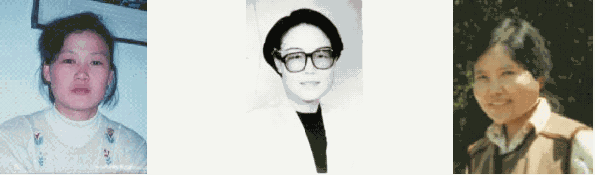
Ma Yanfang Lu Hongfeng Zhao Fulan
Case 1, Changle Mental Hospital, Weifang City, Shandong Province
Su Gang, 32, was a computer engineer working at the Instrument and Meter Unit of the Alkene Plant of Qilu Petro-Chemical Company in Zhibo City. The security officers of the Alkene Plant forcibly sent Su into Changle Mental Hospital simply because he practiced Falun Gong. In the hospital, Su was forcibly injected daily with overdoses of drugs that destroy the central nervous system. After nine days of torture in the mental hospital, Su Gang was discharged home. At this time, Su looked sick, with a dull look in his eyes, and he was expressionless. He was very weak, slow in reacting, and had muscle rigidity. On the morning of June 10, 2000, Su Gang died from heart failure as a consequence of the torture he suffered. (Details: Appendix 1)
Case 2. No. 7 People's Hospital of Hangzhou City, a mental hospital
 ?/P>
?/P>
Shi Bei, female, 49 years old, lived in Lanxi, Zhejiang Province. She was an employee of Fuyang City government in Zhejiang Province. After the Chinese government pronounced Falun Gong illegal in July 1999, Shi Bei and her husband had to report to the police department almost every month.
One afternoon in mid May 1998, Shi Bei was forcibly taken away from home by several plainclothes police and was not released until midnight.
In May 2000, Shi Bei was involuntarily admitted to the No. 7 People's Hospital of Hangzhou City, (mental hospital) by Fuyang City Police Department. Under pressure from the police, the doctors and nurses injected her with supposedly "sedatives." To prevent her from speaking, the police didn't allow her to eat anything for a whole week. Shi Bei was starved to death. On September 10, 2000, Shi Bei died as consequence of torture suffered at the No. 7 People's Hospital of Hangzhou City.
Case 3. Ankang Hospital of Shenyang City
Song Xiangzhen, female, 46 years old, lived in Shenyang City. Zhang Jianlin, the hospital head and Xie Xiaobin, the chief physician undertook brutal and inhumane force-feedings on Song Xiangzhen. They inserted a rigid plastic tube, which was larger than the normal size of the human's nostril, through her nose into her stomach. Although this caused bleeding in her nose and stomach, Zhang Jianlin ordered that they continue the force-feeding. Refusing to cooperate, this practitioner bit off the plastic tube. Zhang Jianlin viciously beat her, with drug addicts assisting her, until Song Xiangzhen's face was seriously injured and deformed. Song Xiangzhen lost consciousness and died.
Responsible People and Work Units, and Their Phone Numbers for Investigation:
Shenyang City Police Department Ankang Hospital, telephone number: 86-24-89347972
Hospital head, Zhang Jianlin, female, 30 years old, originally a guard from Shenyang City Detention Center; Chief physician, Xie Xiaobin, male; Drug addicts: Gao Ming, and Dong Hongtao; Shenyang City Detention Center telephone number: 86-24-23705590
Head of the Detention Center: He (first name unknown); Taochang Police Station in Shenyang City, telephone number, 86-24-88113195
Case 4. Xi'an City Police Department Ankang Jail Hospital, Shaanxi Province
Sun Yuncheng was an employee of a satellite-tracking center. At Xi'an City Police Department Ankang Jail Hospital, Shaanxi Province, police doctors tortured her in various ways and injected her with unknown drugs. When she did not cooperate with drug injections, the police hit her in the face. Each time before she was injected, she was bound to a bed for about ten hours, which caused her hands to bruise. Sometimes she was left to sleep on a bare bed with no quilts or sheets and was not allowed to use the toilet, leaving urine in her trousers or on the bed. During her hunger strike, she frequently vomited yellow fluids, and her urine was red. It was impossible for her to go to sleep at night and she could not swallow her saliva. Even in such a situation, she was force-fed by the policemen. Sometimes the tube was inserted into her trachea. Almost every time, her nose or mouth would bleed because of the tube insertion. Once the police failed to insert the tube into her mouth after over ten tries, and the angry head nurse Liu Qi fiercely hit Sun Yuncheng in her mouth.
Responsible People and Work Unit for Investigation:
Xi'an City Police Department Ankang Jail Hospital, Shaanxi Province
Head nurses: Liu Qi, Dong xx and Chen xx; Section chiefs: Wei Yujun, Hong Kui
Case 5. Xi'an City Police Department Ankang Jail Hospital, Shaanxi Province
Zhang Jinlan, female, 53 years old, was illegally sent to the Ankang Jail Hospital in Xi'an City, Shaanxi Province, where she went on a hunger strike to protest the persecution. A police doctor injected her with an unknown drug that quickly caused her whole body to become paralyzed, and she lost consciousness. In this condition, the police injected her with unknown drugs for seven days. Nobody was on site to nurse her. In the first days of these injections her lower body started to fester. After seven or eight days of these injections, she almost died. Only then did the hospital send a "critical situation notice" to her family, and she was discharged home. Now, she is paralyzed, bedridden and unable to recognize people. Her home is still under "610 Office" surveillance and her family phone is tapped.
III. Related Mental Hospitals to Investigate
1. Anhui Province Female Labour Camp and Anhui Province Mental Hospital, Anhui Province
2. No. 261 Mental Hospital, People's Liberation Army, Beijing
3. Beijing Northern Suburban Rehabilitation Center, Beijing
4. Daliushu Mental Hospital (Dabeiyao Town), Chaoyang District, Beijing
5. Hanzhuang Mental Hospital, Pinggu, Beijing
6. Qinglongqiao Mental Hospital, Haiding, Beijing
7. Anding Hospital (a mental hospital), Beijing
8. Zhoukoudian Psychiatric Hospital, Fangshan, Beijing
9. Huilongguan Hospital (a mental hospital), Beijing
10. Hefei City Mental Hospital, Anhui Province
11. No. 1 Mental Hospital, Chongqing City, Sichuan
12. Pibaping Mental Hospital, Chongqing City, Sichuan
13. Xiemachang Mental Hospital (Beibei), Chongqing City, Sichuan
14. Cangshan Mental Hospital, Fujian Province
15. Weiwu County Mental Hospital, Gansu Province
16. Huizhou City Mental Hospital, Guangdong Province
17. Fangcun Mental Hospital (Guangzhou City), Guangdong Province
18. Baiyun Mental Rehabilitation Hospital (Guangzhou City), Guangdong Province
19. Guangxi Army Mental Hospital, (Liuzhoulong), Guilin, Guangxi Province
20. 191 Hospital (a mental hospital of the Army), Guijiang, Guangxi
21. Longqianshan Mental Hospital, Liuzhou, Guangxi
22. Shengli Oil Field No. 8 Division's Mental Hospital, Hebei Province
23. Hebei Medical University No. 5 Hospital, Psychiatry and Hygiene Division, Hebei Province
24. Feixiang Mental Hospital, Hebei Province
25. Ankang Hospital (Yuehe), a mental hospital run by police, Tangshan City, Hebei Province
26. No. 2 Hospital, Psychiatry Division, Hebei Province
27. No. 5 Hospital, Psychiatry Ward, Hebei Province
28. No. 6 Mental Hospital, Baoding, Hebei
29. Shalingzi Mental Hospital, Zhangjiakou City, Hebei Province
30. Shijiazhuang City Mental Hospital, Hebei Province
31. Handan City Mental Hospital, Hebei Province
32. Tangshan Psychiatric Hospital (5th Hospital), Tangshan, Hebei Province
33. Jingbei Mental Hospital, Harbin City, Heilongjiang Province
34. Jiamusi City Mental Hospital, Heilongjiang Province
35. A mental hospital in Yichun City, Heilongjiang Province
36. No. 2 Affiliated Mental Hospital of Xinxiang Medical Research Hospital, Henan Province
37. A mental hospital in Kaifeng City, Henan Province
38. Macheng Mental Hospital, Hubei Province
39. Xiaogan City Mental Hospital, Hubei Province
40. Wuhan University Yatai Mental Hospital (former No. 1 Affiliated Hubei Province Hospital), Hubei Province
41. Changsha City Mental Hospital, Hunan Province
42. Hunan Province Mental Hospital (94 Chiling Road, Changsha, Hunan)
43. A mental hospital in Zhuzhou City, Hunan Province
44. No. 3 People's Hospital, Mental Section, Wujin County, Jiangsu Province
45. Chengbei Mental Hospital, Kunshun, Jiangsu
46. Jinjiang City Mental Hospital, Jiangsu Province
47. Wutaishan Mental Hospital, Yangzhou City, Jiangsu Province
48. Longgang Mental Hospital, Yancheng City, Jiangsu Province
49. Nanjing Brain Hospital (former mental hospital), Jiangsu Province
50. Qinglongshan Mental Hospital, Nanjing City, Jiangsu Province
51. A mental hospital in Shanghai, Jiangsu Province
52. Kaixuan Hospital (Xiaonan Mental Hospital), Changchun City, Jilin Province
53. Jilin City Mental Hospital, Jilin Province
54. A mental hospital in Liaoyuan City, Jilin Province
55. Shulan City Mental Hospital, Jilin Province
56. Siping City Mental Hospital, Jilin Province
57. Songyuan Division of Yiaonan Mental Hospital, Jilin Province
58. No. 102 Mental Hospital, Treatment Center for Mental Diseases, Changzhou, Jiangsu Province
59. Changzhou Mental Hospital, Jiangsu Province
60. Nanjing Psychiatric Hospital, Section 6, Nanjing, Jiangsu Province
61. Xuzhou Mental Hospital, Jiangsu Province
62. Dalian Drug Rehabilitation Center, Liaoning
63. Tangjiafang Mental Hospital, Anshan City, Liaoning Province
64. Xiaolingzi Psychiatric Hospital, Anshan, Liaoning Province
65. Yingkou City Mental Hospital, Liaoning Province
66. A mental hospital in Lingyuan City, Liaoning Province
67. Lushun City Mental Hospital, Liaoning Province
68. Tiexi District Mental Hospital, Shenyang City, Liaoning Province
69. Lingwu Mental Hospital, Ningxia Province
70. Xi'an City Police Department Ankang Jail Hospital, Shaanxi Province
71. Xianyang Mental Hospital, Shaanxi Province
72. Laixi City Mental Hospital, Shandong Province
73. Beiluo Town Mental Hospital, Shouguang City, Shandong Province
74. Jining City Mental Hospital, Shandong Province
75. No. 3 People's Hospital of Weifang for Mental Illness, Ward 3, Weifang, Shandong Province
76. Changle Mental Hospital, Shandong Province
77. Jining City Daizhuang Mental Hospital, Shandong Province
78. People's Hospital, Psychiatry Division, Qishui County, Shandong Province
79. Qilin Town Psychiatric Treatment Center, Linzi District, Zibo, Shandong Province
80. Zhucheng City Mental Hospital, Shandong Province
81. Weifang Rehabilitation Hospital-Mental Patients' Ward, Weicheng District, Weifang City, Shandong Province
82. Jiaozhou Mental Hospital, Qingdao City, Shandong Province
83. A mental hospital in Jimo City (Qingdao), Shandong Province
84. China-Korea Mental Hospital, Laoshan, Shandong
85. Qixia Mental Illness Rehabilitation Center (Psychiatric Recovery), Yantai City, Shandong Province
86. Yantai Psychological Rehabilitation Center (former Laiyang Mental Hospital), Yantai City, Shandong Province
87. Beimen Mental Hospital, Suining City, Sichuan Province
88. No. 6 Hospital (a mental hospital), Pingdu City, Shandong Province
89. Shandong Provincial Mental Hospital, Jinan, Shandong
90. Laiyang Mental Hospital, Laiyang, Shandong
91. Zhongshan Mental Hospital, Laoshan, Shandong Province
92. Linyi Mental Hospital, Shandong
93. Mental Hospital of Jiaozhou (also called Jiaozhou Psychological Recovery Center), Jiaozhou, Shandong
94. Mental Illness Section, Kunlun Hospital, Zibo Mineral Bureau, Shandong
95. No. 5 People's Hospital (former mental hospital), Zichuan District, Zibo City, Shandong Province
96. The Rehabilitation Hospital under Civil and Administration Bureau of Weifang City, Shandong Province
97. A drug rehabilitation center, Chengdu City, Sichuan Province
98. Pengzhou City Mental Hospital, Sichuan Province
99. Xiemachang Mental Hospital, Ore Mine Sanatorium, Mental Illness Division), Chongqing, Sichuan Province
100. Beimen Mental Hospital, Suining
101. Hemujing Mental Hospital, Xinji City
102. A mental hospital in Xinjiang (autonomous region)
103. Kangning Hospital (Kangzhuang Mental Hospital), Ningbo City, Zhejiang Province
104. No. 7 People's Hospital (a psychiatric hospital), Hangzhou City, Zhejiang Province
IV. To be investigated:
Zhang Honglin: From September 10 to 29, 2001, Zhang Honglin went to nine cities and districts in Fujian Province for the fifth time to assist the local "610 Offices" to directly persecute Falun Gong practitioners. He was one of the earliest propagandists to support the persecution of Falun Gong practitioners in mental hospitals. He actively requested to participate in first-hand persecution and he actively planned for the persecution. He published the following suggestions:
1. Central government organizes experienced local psychiatrists to diagnose Falun Gong practitioners with mental illnesses
2. First, weaken Falun Gong practitioners with psychiatric methods, and then "transform" them.
Main crime:
Slander articles:
1. "'Falun Gong'..." published on People's Daily on February 2, 2001.
2. "Professionals Suggest After Studying Many Cases: for 'Falun Gong'..." published on March 7th issue of People's Daily and 103rd issue of Information Collection.
3. "Zhang Honglin, medical doctor and research fellow of China Academy of Traditional Chinese Medicine thinks..." published on April 9 Beijing Daily 5414th issue of Internal Reference.
4. "Talk About 'Falun Gong'..." A TV program at CCTV, reported on http://www.minghui.org/mh/articles/2001/12/28/22191.html (Chinese version)
Appendix 1:
On June 23, 2001, The Washington Post published a commentary condemning the Chinese Party's continuing persecution of Falun Gong practitioners by forcing them into mental hospitals against their will, where they were abused, and it called for democratic governments in the world and international human rights organizations to further expose the Party's inhumane abuses. The story of the 32-year-old computer engineer Su Gang who was repeatedly arrested by the security department of his company because he refused to give up practicing Falun Gong was especially shocking... after he protested the ban on Falun Gong in Beijing on April 25, Su Gang was arrested for the second time. On May 23, the Alkene Plant of Qilu Petro-Chemical Company where he worked authorized the police to have him involuntarily admitted to a mental hospital.
According to Su Gang's father, the doctor gave Su Gang forced injections twice a day, every day, of unknown drugs that damaged his central nervous system. One week later when he left the hospital, Su Gang could not eat or move his limbs. On June 10, 2001, the formerly healthy young man died of heart failure.
The Washington Post June 23rd Report: Father Appeals and Receives Detention
Su Gang's father Su De'an said during the interview yesterday that he appealed to related government agencies regarding Su Gang's death but was detained as a result. Now, he is under surveillance by the police and can't move about freely.
He choked and said, "It'll be hard to receive justice on this, but I want to say to them, 'you can't do something this bad!'"
Mingpao: Falun Gong Practitioner Dies Suddenly After Release and Forcibly Sent to Mental Hospital and Injected With Drugs, reported on
http://package.minghui.org/gb/0001/Jun/23/news media 062300.html (Chinese version)
Appendix 2: Falun Dafa Information Center: http://www.faluninfo.net
Appendix 3: Judicial Psychiatry in China and Its Political Abuses, Robin Munro, Columbia Journal of Asian. Law Volume 14, no.1, 2000.
Appendix 4: Fang Lihong, male, 37 years old, technical school graduate and traffic policeman at Anshan City Police Department in Liaoning Province. When interviewed by the Washington Post, Fang Lihong said, "I was very scared", "I don't have any mental illness but I was forced to stay with other mental patients for 16 months".
Fang Lihong said he was forced to take drugs everyday at Kangning Psychiatric Hospital in Anshan City, Heilongjiang Province. Later, the hospital gave him pills and asked him to take them on his own in his room. He said the doctor told him they knew he wasn't ill but still had to "treat" him according to higher orders.
During the 45-minute interview, Fang spoke clearly and appeared rational. In February, according to Falun Gong practitioners in the United States, police caught him in southern Fujian Province and he died in their custody, apparently from physical abuse. A doctor at Kangning Psychiatric Hospital confirmed the mental hospital had treated Fang and had been informed of his death, but he declined to discuss the case further.
Zhu Jianlin, China Times: Fang Lihong Beaten to Death, August 27th 2002 Taipei report, http://search.minghui.org/mh/articles/2002/8/27/35688.html (Chinese version)
Appendix 5: Dangerous Minds. Robin Munro. Published by Human Rights Watch and Geneva Initiative on Psychiatry, 2002.
Appendix 6:
Wu Xiaohua was an associate professor of Anhui Province Construction Engineering College. In July 2000, she was detained 50 days in Hefei City Mental Hospital, Anhui Province. In late October 2000, she was again detained and the doctors at the mental hospital approached her and tried to forcibly take off her clothes without asking any questions about her condition. She was surrounded by nurses who pinned her on the bed; they yanked her hair and stripped her of her clothes. The doctor cursed as he cut Wu's underwear with scissors, then they tied her with her arms and legs stretched out on a bed with four ropes and shocked her whole body; they used electric needles on her, force-fed her drugs and gave her injections used to treat mental illnesses. As a result, Wu Xiaohua's mind became muddled, her head grew heavy and she was unstable. Since late October 2000, she had been detained in the mental hospital for more than 130 days. The head physician, Dr. Wang Li cursed Wu Xiaohua for holding a hunger strike. Wu Xiaohua held three hunger strikes during this period and Dr. Li said, "I'm not afraid that you won't eat. We have all kinds of ideas here." She also said, "if you go on hunger strike again, we'll use Electroconvulsive Therapy on you." ECT was designed to help people with their illness, now it has become a tool of torture. The hospital was used to brutally torture Falun Gong practitioners.
Wu Xiaohua was forcibly sent to a mental hospital for more than one year. In the hospital, she suffered indescribable trauma as she was forcibly injected and force-fed with drugs, and shocked with electricity. After the intake of the drugs, she became lethargic and almost unconscious. She was uneasy when sitting, standing and sleeping. She was dizzy and she vomited violently. Her menstruation became irregular and her mind sometimes went blank. Her memory was impaired and her vision became at times obscure. Her vision was blurred for objects at a close distance and her hearing was greatly diminished. She was extremely weak and at times, she lost consciousness three to four times a day. After more than one year of forced detention in the mental hospital, in early October 2002, two guards from Anhui Province Female Labor Camp took Wu Xiaohua away.
Anhui Province Female Labor Camp; Chief's office: 86-551-5315739
Labor camp's office: 86-551-5312701; Xia Luping, Deputy director of Anhui Province Construction Engineering College: 86-551-3516763 (office), 86-551-3510061 (home)
Hu Chuanjian, Party secretary of Anhui Province Construction Engineering College
Appendix 7: At the annual meeting of the American Psychiatric Association in May 2001, the leadership passed Item 12H "Condemning the Chinese Government's Misuse of Psychiatry" proposed by Dr. Nicholas Stratas and Dr. Peggy Dorfman from North Carolina
Appendix 8: http://www.clearwisdom.net/emh/articles/2001/7/13/12190p.html
Appendix 9: http://www.clearwisdom.net/emh/articles/2002/8/27/25831p.html
Appendix 10: U.N. General Assembly. Report of the Third Committee, A/46/721. Principles for the Protection of Persons with Mental Illness and for Improvement of Mental Health care. December17, 1991
Appendix 11: The World Psychiatric Association passed and demanded that all 119 member nations follow international professional ethical standards for treating mental illness. The Declaration of Hawaii passed in 1977; the Madrid Declaration on Ethical Standards For Psychiatric Practice passed in 1996. http://www.wpanet.org/home.html
Appendix 12: The Nuremberg Trials: Chronology(c) 2000
http://www.law.umkc.edu/faculty/projects/ftrials/nuremberg/NurembergChronology.html November 29, 1945
Category: News & Events