



Nima Arkani-Hamed, a physicist at Harvard University, believes that the first results from the Large Hadron Collider, the world's most powerful particle accelerator, are expected to be released by CERN, the European particle-physics laboratory near Geneva, Switzerland, by 2008. And if Arkani-Hamed's predictions are correct, then that is when an experiment will detect the first evidence to support string theory -- a vision of the cosmos that has never been experimentally verified. "The field is going to turn on what happens at the collider." he says.
Pacing in his sparse Harvard office, the 32-year-old physicist drank no less than six cups of espresso during our ninety minute interview, as he tries to explain why he believes that string theory can now be tested.
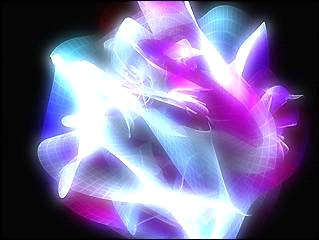
This is a supposed six dimensional space cast to a two dimension plane, which is called Calabi-Yau shape. The image shows the twists and bends inside the space. The twist and bend of space can form a shortcut between spaces, a worm hole.
String theory emerged in the 1980s as a way to answer questions that still baffle modern physics, such as why gravity is so much weaker than other fundamental forces? By imagining that everything is composed entirely of strings ten billion billion times smaller than atomic nuclei, theoretical physicists were able to create a model of the universe that unifies all fundamental forces into one, and describes most of the particles we see today. Unfortunately, these strings are far too small to be detected by even the most powerful particle accelerators. And so, critics say, they are more philosophy than physics.
Arkani-Hamed's ideas have very little to do with strings themselves. Instead, he is hoping to detect the extra dimensions predicted by the theory, which like the strings, are thought to be vanishingly small. But in 1998, Arkani-Hamed and his colleagues published calculations showing that some of these extra dimensions might be as large as a millimeter (N. Arkani-Hamed, S. Dimopoulos and G. Dvali Phys. Lett. B 429, 263-272; 1998). Such large dimensions, they argued, have escaped detection because everything we know -- except for gravity -- is confined to the three dimensions of space, and one of time. But gravity, they think, might be able to seep into these extra dimensions. This would explain why it seems so weak to us. And, as a result, unexpected variations in gravity could allow researchers to detect the hidden dimensions.
Leaking away
"It was a watershed event in the field," recalls Joe Lykken, a
theoretical physicist at Fermilab near Chicago, Illinois. Suddenly, a theory
that most thought could never be tested was within experimental reach. Some
groups rushed to look for deviations in gravity at small scales. So far, they
have nothing to report, but the hope created by Arkani-Hamed's work was enough
to win him wide praise. "The word 'genius' is overused, but I think it is
easily applicable in the case of Nima," says Savas Dimopoulos, a Stanford
theorist and one of Arkani-Hamed's collaborators.
The son of two Iranian physicists, Arkani-Hamed was born in Houston, Texas, and grew up in Boston. After the Iranian revolution of 1979, his family returned to their homeland, but as religious fundamentalists took over the government, his father was forced to go underground and the family eventually had to flee across the border to Turkey. By 1982, Nima was living in Toronto, Canada.
Recalling his early life, Arkani-Hamed says that his time in Iran was largely a positive experience. "The strange thing is that I have mostly wonderful memories," he says. If anything, he adds, it taught him to worry less about what others thought of him. "Given that so many aspects of my life have been unusual, I've never had a problem with feeling different or being different or doing different things."
As a child, Arkani-Hamed loved physics, but he initially disliked almost everything about string theory. "String theory just seemed like abstruse junk to me," he says. "What I really liked was physics that explained things about the world around me."
That changed when he began studying quantum field theory at the University of Toronto. At first, this complex theory, which underlies high-energy physics and much of string theory, seemed too arcane, but as he studied it more carefully, he found a level of order and explanation far beyond anything he had learned before. "Clearly, there was something very deep going on," he says.
It captivated him, and by the time he finished graduate school in 1997, he knew he wanted to try to make string theory experimentally verifiable. He found an ally and mentor in Dimopoulos, who has devoted his career to seeking testable versions of string theory. "We believe that the only way to make progress is to take an idea, and push its consequences to find observations," Dimopoulos says.
These days, in late-night phone calls and frequent e-mails, the two are thinking about what might emerge at the Large Hadron Collider. Their current calculations show that some of the energy created by particle collisions in the machine could escape into extra dimensions, and be carried off by leaking gravity if those dimensions are large enough. The result would be an apparent violation of the conservation of energy -- a dramatic sign that string theorists are on the right track.
Then again, they might not be. "You can spend ten years of your life and have every idea you came up with be proven wrong, and that's gratifying in its own way," Arkani-Hamed says. But, he adds as he reaches his caffeine-fueled conclusion: "If this thing turns out to be true, it could be the biggest discovery in science in, say, 300 years."
Source: http://www.nature.com/cgi-taf/DynaPage.taf?file=/nature/journal/v433/n7021/full/433010a_fs.html