"Made in China"--the Truth about the Secret Factories in Chinese Prisons (Part 2) (Photos)
Part 1: http://www.clearwisdom.net/emh/articles/2007/8/4/88301.html
(Clearwisdom.net) The Chinese Communist Party (CCP) has declared to the world, "No other country in the world can provide export goods with fast delivery, cheap prices and good quality as well as China." The CCP also acknowledged, "Cheap labor is the key factor making Chinese products very competitive." But the international society does not realize that the Chinese Communist Party is using nearly zero-cost slave laborers in the prison system to compete with other countries.
Right now several million modern slave laborers, in more than 1,000 prisons and forced labor camps in China, are working day and night under conditions dangerous to human health and life. Slave laborers who become infected with tuberculosis, skin diseases, hepatitis, and venereal diseases are not isolated and treated effectively. They are forced to continue to work. The products made by these laborers include toys, bedding products, fashionable clothing, underwear, cotton balls, toothpicks, single-use chopsticks and so on. Products made under forced labor, which were poisonous or infected or of bad quality have been sold around the world and entered millions of people's homes.
Under the Chinese Communist Party's genocidal policy against Falun Gong practitioners, the prisons and forced labor camps use extremely intensive forced labor and brutal torture to destroy Falun Gong practitioners' bodies and minds, in order to force them to give up their belief in "Truthfulness-Compassion-Forbearance". By searching clearwisdom.net, one can find more than 5,000 articles exposing the persecution of Falun Gong practitioners, happening in nearly all the country's provinces, municipalities and autonomous regions. But this is just a small portion of the cases. Under the CCP's censorship and deceitful propaganda, many more crimes are still concealed.
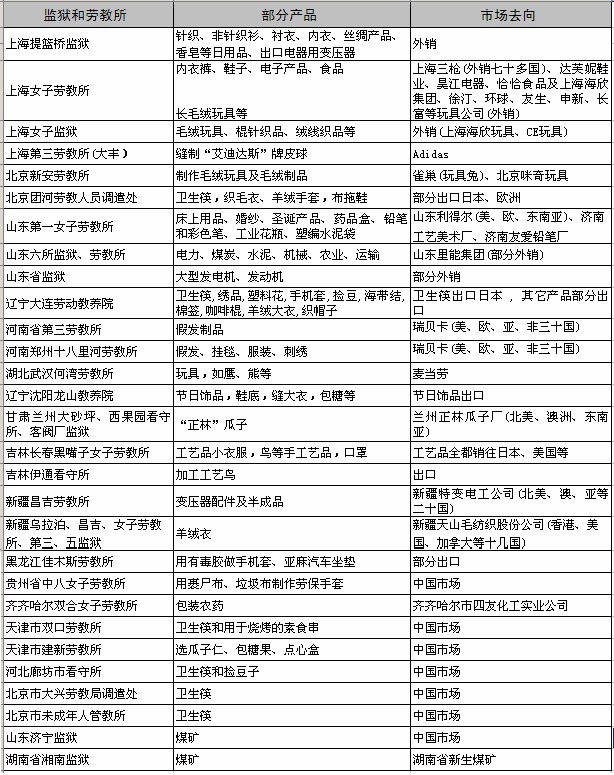
Some of the products that Falun Gong practitioners have been forced to make
The Chinese Communist Party uses the false appearance of the economic boom and cheap goods as a weapon to seduce governments and companies to ignore the brutal persecution of Falun Gong in China. Unfortunately, certain companies help the CCP to do evil. The CCP also deceives business and the public, who do not know about the persecution. They unknowingly purchase the products produced under forced labor from the CCP, making them participants in the persecution of righteous belief and human rights.
The "International Metropolis" of Shanghai Brutally Enslaves Laborers in Prisons and Forced Labor Camps
Shanghai, the so-called "international metropolis", is used by the CCP to fabricate the lie that this is "the best time for human rights" in China. But inside the prisons and forced labor camps, beautifully landscaped on the outside with flowers and green grass, many prison factories have been built. The factories all violate human rights and World Trade Organization rules. Many modern slave laborers are forced to work very hard at the product assembly lines in the factories. In order to avoid international satellite monitoring, the prisons and labor camps use fully sealed freight trucks to ship the raw materials and products. The freight truck traffic in the prison factories is as busy as Shanghai's ordinary factories.
The prison laborers are not allowed to sleep if they cannot finish their assigned work. It is very common to detain the laborers after their prison term should be finished. Laborers are often punished with electric batons. They have been forced to line up and the prison guards use electric batons to beat them one by one. Sometimes the police used up to eight electric batons to hit a prison laborer's head and back. It often happens that some laborers cannot endure the brutal torture and commit suicide. The prison guards have made statements like, "Prisons are the basis for manufacturing export goods. If you cannot finish the scheduled production within the given time, and delay our export contract performance, do not even dream of getting out of here alive!"
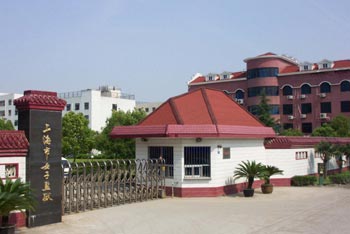
The nicely landscaped main entrance of the Shanghai Women's Prison
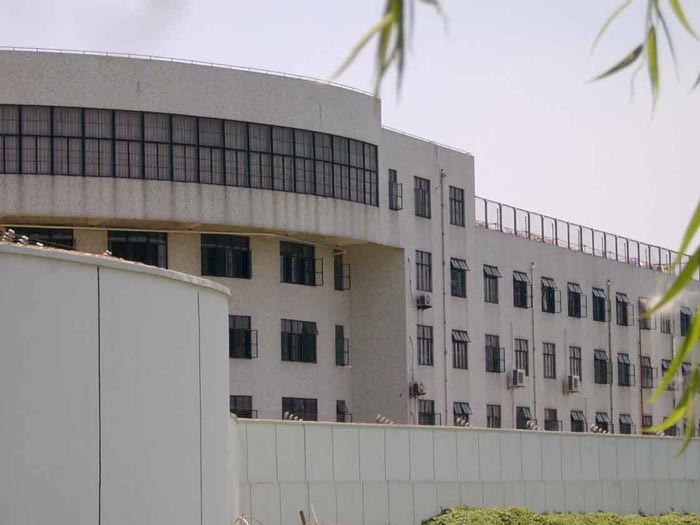
The rear view of the Shanghai Women's Prison
The Shanghai Women's Prison primarily focuses on producing and exporting plush toys, knitted goods and wool fabrics. The major companies who have worked with it include the Shanghai Haixin Toy Limited Company, the CE Toy Limited Company and others.
Shanghai's Tilanqiao Prison is called "a hundred years prison". It was built in 1901 and was expanded and rebuilt after that. Right now there are more than ten buildings in the prison complex. Because of the well-built construction and large scale, the prison was known as "the No. 1 Prison in the Far East". This prison was landscaped with many flowers and green grass. The CCP also spent a lot of money to build a prison museum in order to deceive the public. But it is hard for people to imagine that this garden-style prison is actually a living hell.
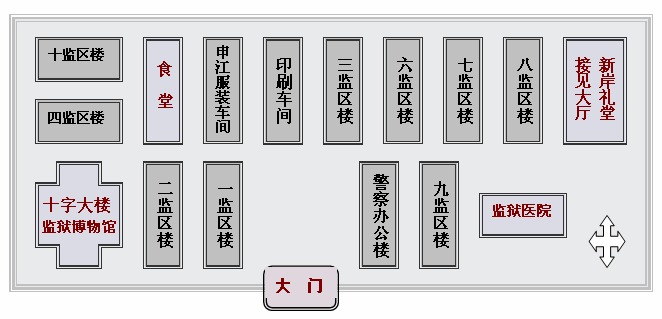
The layout of Tilanqiao Prison in Shanghai
The Fourth District of Tilanqiao Prison is a clothing export factory covered by tall walls and electrical wires. It produces many kinds of knitted clothing and other kinds of shirts, clothes and underwear. It is called "Shenjiang Clothing Factory" externally. Many export trade companies in Shanghai directly send orders to this factory. In 2001, the prison laborers in this factory were forced to work more than 15 hours every day to finish a rush order for producing police uniforms for six provinces and one city in eastern China. Based on the Shanghai Prison Administration Bureau and the Forced Labor Bureau's internal newspaper, "Inside and Outside the Wall", this factory has advanced imported equipment and has the ability to produce 400,000 items of clothing every year. In 2005, the annual production was 5.88 million yuan and the profit was 4.84 million yuan.
The First District primarily focuses on the massive production of many kinds of electric transformers used for export electric appliances such as computers, home appliances and other electronic products. The Second District was originally where death row prisoners were held. Right now the Falun Gong practitioners who refuse to give up their belief are also detained here separately. This district is mainly used for packaging export soaps and other daily necessities. The Tenth District is used for producing and packaging all kinds of scarves and handkerchiefs. The Sixth, Seventh and Eighth Districts also have different product assembly lines.
The prison has established policies for encouraging the guards to persecute Falun Gong practitioners. The prison guards can get a 4,000 yuan bonus if they "transform" a Falun Gong practitioner and force the practitioner to sign a guarantee statement or a repentance statement to give up practicing Falun Gong. The guard will also be promoted and be given a house if they have "transformed" three to four Falun Gong practitioners. Under these policies' influence, the prison police have used all kinds of brutal ways to persecute Falun Gong practitioners. They also use sentence reduction and workload reduction to induce criminal inmates in the prison to monitor and persecute Falun Gong practitioners.
The practitioners who remain steadfast in their belief in "Truthfulness-Compassion-Forbearance" and have refused to do the slave labor are isolated in a 3-square-meter cage. They are forced to sit on a very narrow stool for 15 hours every day. They are not allowed to close their eyes or move. If they do not give up their belief, they will be forced to sit like this every day for years. Many practitioners' buttocks develop sores as a result of this torture. Their underpants are soaked with blood and stick to their body. If they take off the underpants, a piece of flesh is torn from the body. The prison police use these brutal methods to break the practitioners' will.
Many Falun Gong practitioners use huger strikes to protest against the illegal persecution. For example, the winner of the Chinese National Olympics Chemistry Contest's top prize and Chinese National Olympics Math Contest's Gold Medal, Mr. Qu Yanlai, started a hunger strike from the first day of prison. He has now been on the hunger strike for almost five years. The guards brutally torture him with forced-feeding. They purposely poked around inside Mr. Qu's stomach with a plastic feeding tube and caused his stomach to bleed for over four months. After this torture, the guards dragged him up and down concrete stairs, scraping the skin and flesh off his legs until his bones were exposed. They kicked Mr. Zhou Bin in the lower body and ordered inmates to stomp on his ankles. As a result of this abuse, his penis and ankles were seriously injured. Practitioners Xiong Wenqi and Du Yan were tied up to beds for a very long time, and force-fed on the beds. Due to this torture, their esophagi bled severely bled and the muscles in their arms and legs atrophied seriously. Zhang Yiming was forced to stand with a chamber pot on his head for a long time. The abusers tortured him further by pushing his head into the chamber pot.
Practitioners who refused to be "transformed" and to perform labor in the Third Labor Camp of Shanghai City have been transferred to Qingpu Hospital. In October, 2003, Lu Xingguo was beaten to death one hour after arrival. His body was disfigured. There was no skin on his lips and no teeth in his mouth. His neck was covered with blood. Guo Jinfu was beaten with five electric batons at the same time, until he could not control his bladder and bowels.
Bloody Slave Labor Behind Internationally Renowned Brand
Xinjiang Tianshan Wooltex Stock Co., Ltd. is the first Chinese and foreign joint venture woolen textile enterprise in China, with joint venture capital from four companies, including Urumqi Woolen Textile Co., Hong Kong Tianshan Woolen Textile Co., Ltd. (which consists of Hong Kong Peninsula Knitting Co., Ltd., Dongyang (Japan) Spinning Industry Co., Ltd.), and Hong Kong International Cotton Industry Co. In 1998, the company stock was allowed to trade on the stock market. The company purchased equipment and technology from Japan, Germany, and Italy. Experts from Japan and Hong Kong came to the company to help with their production. Currently, the annual production is 2 million wool sweaters. Their products are exported to more than 10 countries and areas, including Hong Kong, the USA, and Canada.
Beginning in the 1990's, in order to increase their ability to compete internationally, Tianshan Wooltex Stock Co., Ltd. started to develop deals with several of the prisons and labor camps in Xinjiang Province. Their wool sweater manufacturing plants can be found in Wulabo Labor Camp, Women's Labor Camp, Changji Labor Camp, and the Third Prison, and Fifth Prison of Xinjiang Province. After the CCP started to persecute Falun Gong in 1999, a large percentage of Falun Gong practitioners in Xinjiang Province were illegally arrested. Falun Gong practitioners were major targets for forced labor.

Xinjiang Tianshan Wooltex Stock Co., Ltd.
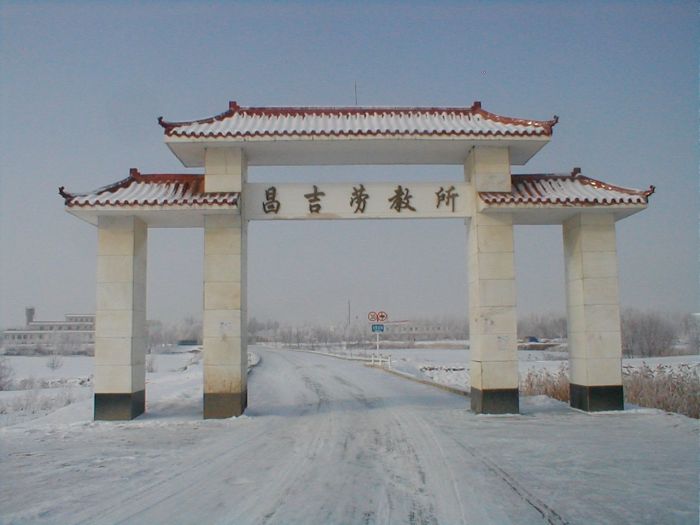
Changji Labor Camp of Xinjiang Province
Xinjiang Tianshan Wooltex Stock Corporation, Ltd. tries its best to cover up this crime of profiting from forced labor. The "Tianshan" trademark was identified as a "famous Chinese brand" by the State Administration of Industry and Commerce. "Tianshan" products were awarded the State Quality Certificate of Exemption from Inspection from 2002 to 2005. Moreover, Tianshan Wooltex produces sweaters for other well-known enterprises in the world, such as Banana Republic, Neiman Marcus, Holt Renfrew, Ports, Minimum, Bon Genie, Tutti Colori, Espina, Cream, Anivee F, Son June Wan, French Connection, and others. Orders from Banana Republic have numbered over 200,000 pieces in a recent year.
When Tianshan Wooltex receives an order, it sends it over to the labor camps and prisons. In order to meet the tight deadlines, the guards at the labor camps and prisons often coerce the detainees to work days on end with no sleep. They can only take a short nap after dawn on the platform where they make the sweaters. Many detainees work an average of more than 20 hours a day for 10 to 15 consecutive days. Most of them have swollen legs from malnutrition and the exhausting labor conditions. The workshop is only 200 meters (about 850 feet) from the cafeteria, but most detainees do not have time to eat breakfast. The guards often bring in a bucket of porridge -- lunch for the detainees. The guards treat the detainees as robots, and when they are too exhausted to work, the guards will give them a whipping to force them to continue.
The prison guards are especially malicious in torturing Falun Gong practitioners. They load Falun Gong practitioners with heavy labor assignments in the daytime and force them to manufacture wool sweaters in the evening, in order to break practitioners mentally and physically and force them to give up their belief. If a practitioner is found to fall asleep, the other prisoners will use needles and scissors to poke the practitioner, or use bricks to hit the practitioner's chest and back. If a practitioner cannot finish the assigned work or makes a mistake, the guard will tear off the practitioner's clothes, handcuff him (or her) to a heater pipe, and beat the practitioner with electric batons on sensitive body parts, such as the neck, armpits, lower body, mouth, or ears. In addition, the practitioner's prison sentence will be extended. Every time government inspectors come to the labor camp, the guards fear that Falun Gong practitioners may expose the truth, so they lock them in the basement or force them to work in the fields until the inspectors have left.
The "Made in China" label is stained with blood and tears as well as viruses
In CCP prisons and forced labor camps, inmates and Falun Gong practitioners live under extremely poor conditions. They are fed with mildewed yellowish rice. Because this rice contains carcinogenic aflatoxins, it is forbidden to be sold on the market. Since they have to eat this "toxic rice" as well as engage in forced labor, most of the detainees become weak and suffer from many illnesses. Various infectious diseases are being spread in those prisons and forced labor camps, including tuberculosis, hepatitis, scabies, and sexually transmitted diseases. Not only do the inmates not receive proper medical treatment in time, but they are forced to work with viruses and bacteria all over their bodies. They keep sewing products for beds, stitching labels on underwear, making sweaters, and producing stuffed animals until they can't continue.
In order to meet a deadline producing Christmas candles in 2001, Falun Gong practitioner in Longshan Forced Labor Camp in Shanyang City regularly worked from 7:00 a.m. to 5:00 p.m. every day. They often were forced to work extra hours until 1:00 or 2:00 a.m. the next day. The poisonous chemicals in the colorful wax sent out an unpleasant smell. Many people felt weak, pale, and suffered from headaches, loss of appetite, or even shock. Practitioners were forced to use poisonous glue to produce the plastic boxes for the candles. Their fingers often became inflamed and the skin of their fingers often adhered to the plastic boxes.
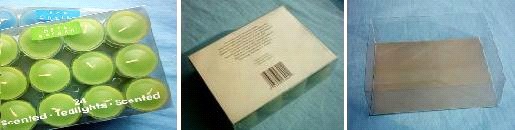
"Made in Thailand" printed on the boxes for Christmas candles
In the winter of 2000, Falun Gong practitioners in Masanjia Forced Labor Camp in Shanyang were forced to wash dirty and bloody chicken feathers in the sinks of their prison rooms. After the feathers were dried indoors, they were used for making butterflies and other crafts exported to the US. Practitioners were not allowed to go to sleep until midnight. They slept in the rooms full of feathers. They were not given any dust masks or gloves, and the air in the rooms was very difficult to breathe.

Examples of crafts made in forced labor camps - feather butterflies and flowers
In March 2003, the Jiamusi Forced Labor Camp accepted illegal production projects from a certain factory in order to seek huge profits. The camp guards forced all detainees to make cell phone cases and flax cushions for car seats with toxic raw rubber materials. Irritating smells from the rubber spread all over the workshop. The guards on duty could not stand the smell and asked the Technical Supervision Bureau to send their people to check it out. The result turned out that the toxin levels in the raw materials were well above the industry standards and could cause cancer. The products made from the toxic raw materials brought harm to consumers. Since then, the guards preferred to stay outside in the cold even in December, instead of entering the workshop. But they forced the detainees to work overtime every day in order to meet the extremely high production quota. Many detainees suffered from constant runny noses and nose bleeds, swollen eyes, irregular heartbeat and difficulty breathing. Their health was severely harmed. The Falun Gong practitioners who protested the enslavement were punished by the guards. Some practitioners' ear drums were ruptured from the severe beatings. Some practitioners' arms turned black from the beatings. Other practitioners lost their eyesight from being slapped by the guards.
Between 2000 and 2003, the Beijing Juvenile Detention Center detained more than a thousand people. 70% of the detainees were adults. The Ninth Division detained 50 Falun Gong practitioners. The oldest one was 72 years old. The detainees were forced to package "sanitary" chopsticks. The daily quota was 10,000 pairs. In order to speed up packaging and reduce the paper's rubbing on hands, the detainees usually wet piles of package paper in water ponds on the ground. Some juvenile criminals even dampened the package paper in their sweaty shoes. All persons who had packaged these chopsticks swore they would not use "sanitary" chopsticks any more. In order to make use of every minute, the detainees tried their best to drink less water to avoid having to use the restroom. Although they kept working continuously for 15 hours, they could hardly complete the quota. Their fingers cracked and bled from constant abrasion. They felt aches throughout their bodies and could not stand up after prolonged sitting. They suffered every minute in extreme pain.
The Second Division of the Zhongba Women's Forced Labor Camp in Guizhou Province has a workshop that specialized in making "safety" gloves. All the inside layers of the "safety" gloves are made from contaminated, discarded cloth recycled from funeral homes, hospitals and dump stations. These recycled materials are directly re-used, untreated, in the manufacture of these gloves. The contaminated fabric is terribly filthy and full of blood stains, dirt and mildew. Death notices are often seen among the fabric. In the workshop, the air stinks. Flies cover the floor, walls and ceiling. The detainees are forced to work with no protection. Dirt and stains harboring unknown germs and viruses fill their mouths and noses, and cover their bodies. Many detainees in the Second Division suffer from ulcerated sores on their hands and feet that ooze pus. Some people's infections leave gaping holes on their feet and are severe enough to expose the bone.
Some criminals in the prison workshop of the Tianshan Wooltex Stock Corporation, Ltd. in Xinjiang intentionally wipe the filthiest things on the sweaters as a form of revenge. Because the sweaters are processed by ironing, the dirty things and blood usually disappear after the final production step. However, those sweaters still carry their felonious curse and contaminated blood. The criminals in the plush toy workshops in the labor camps and prisons in Shanghai City also vented their resentment onto the products they were making and even intentionally spit into the inside of the toys.
How can people of conscience not feel for these people who are forced to take on such arduous work, and not be saddened about such human degradation? How can they not feel concern for those who "enjoy" these products made in forced labor camps?
Teamwork is stopping the persecution of Falun Gong and eradicating the poisonous tumor that is the CCP
Recently, the fake, inferior and poisonous products made in China have been exposed in all countries, shocking the whole world and raising the world's concern. The world's people are starting to search for the root of the problem and to seek countermeasures.
Traditional Chinese values and beliefs have been destroyed by the Chinese Communist Party. When the CCP mobilized the entire country's machinery to wipe out the principles of "Truthfulness, Compassion and Tolerance" from Chinese people's hearts and "making money" become the Chinese people's number one value, human beings were reduced to slaves and a source for live organ harvesting. Illegal brick kilns utilize child slaves. Labor camps make bloody products. Markets are filled with fake, inferior and poisonous goods. Falun Gong practitioners' organs are harvested while they are still alive and sold for huge profit. These "unheard of evils," beyond people's imagination all over the world, are taking place in the country under the control of the CCP, and spreading outward, making everyone a victim.
If the world's people accept communist totalitarianism over the universal values of "Truthfulness, Compassion and Tolerance," they will promote the spread of the cancer cells that swallow human conscience and destroy the international economic order. If this happens, what kind of future will China and the whole world have? We hope that the world's people are not blinded by the false images of the thriving Chinese economy, and are not enticed by the short-term profits offered by the CCP. We urge people to clearly recognize the CCP's evil nature and support the tide of quitting the CCP, which now includes 24 million people. The Chinese Communist Party is being uprooted. At this critical historic moment, we should join the righteous momentum, cooperate in stopping the CCP's persecution of Falun Gong, and eradicate the CCP - a poisonous tumor harming all humanity. Let us each make our own effort towards upholding justice and conscience.